Author: Martin Kallenbach

  • The Four Reviews That Keep a System Honest

    At the end of the naming post I said the review cadence would come next, “because that’s where a good system most often quietly fails.” I want to make good on that, because it’s true, and because the failure is so ordinary that almost everyone reading this has lived it.

    You build the system. You set it up beautifully. For a few weeks you keep it current. Then a busy stretch comes, you skip a review, then another, and one morning you realise you haven’t actually looked at the thing in a month. The system is still there. It’s just no longer connected to your life. It has become a museum of intentions.

    The cure is not more discipline. I tried that for years and it doesn’t scale — the master pattern of my own life is that I thrive on structure and rhythm and falter on raw willpower. The cure is a cadence: a small number of recurring reviews, each with a distinct job, each at the right interval. Get the rhythm right and the system maintains itself almost as a side effect. Get it wrong — or collapse it into one undifferentiated “review when I remember” — and it dies the quiet death above.

    Four reviews, four different jobs

    The mistake I made early on was treating “review” as a single activity I’d do whenever I had time. It isn’t one activity. It’s four, and they answer four different questions on four different clocks. Mixing them up makes all of them worse: you end up doing strategy when you’re tired and tactics when you should be thinking big, and neither gets done well.

    Daily — orientation. This is the smallest and the most important. Each morning I open my journal as a kind of cockpit and have a short standup — these days that’s a conversation with an AI assistant that doesn’t just list my tasks but asks me what actually matters today. The job here is not planning the week or judging the month. It’s narrow: given everything in front of me, what is the one honest answer to “does what I’m doing today bring me closer to where I want to be?” Five or ten minutes. If the daily review tries to do more than orient, it becomes a chore you’ll start skipping, and the daily is the one you cannot afford to skip.

    Weekly — feel and direction. Once a week I step back and ask a softer, more human question: how did that go? Not the numbers — the texture. Did the week feel like mine, or did it happen to me? Where did I drift? What kept getting bumped, and is that telling me something? The weekly review is where you catch a problem while it’s still a wobble and not yet a pattern. It’s also where you notice the good — the things worth celebrating before they vanish under next week’s noise. I keep it reflective on purpose; the moment it becomes a status meeting with myself, it loses its value.

    Monthly — data. Once a month I look at the things that only make sense in aggregate: the ledger and the month’s actual spending, health and movement, progress against the goals I set when I was thinking clearly. Feelings are a poor guide here; numbers are honest in a way that a busy month’s self-narrative is not. The monthly review is where “I think I’m doing fine” meets “here is what the data says,” and the gap between those two is usually the most useful thing I learn all month.

    Quarterly — strategy. Four times a year I ask the largest question: am I doing the right things at all? This is where I revisit purpose against the four domains I organise my life around — Contemplation, Constitution, Community, and Craft, in that priority order — and ask whether my actual calendar reflects that order or quietly inverts it. The quarterly review is the only one slow enough to change direction rather than just speed. It’s also the one most easily crowded out, precisely because nothing breaks if you skip it this quarter. That’s exactly why it needs a fixed slot, booked in advance, treated as non-negotiable.

    Why the rhythm itself is the point

    Here’s the part I underestimated. The cadence isn’t just a maintenance schedule for the system — it’s the main thing protecting me from the technology I use every day.

    John Lennox, writing recently about living well in an age of intelligent machines, makes the point that much of our software is designed to keep us in the immediate: engineered for engagement, for the next notification, for one more scroll. He even recommends periodic “electronic fasting” — deliberately stepping back from the devices that are built to hold you in the perpetual now. I think the review cadence does something similar from the inside. Every one of these reviews is a deliberate climb out of the daily stream to a higher vantage point — weekly, then monthly, then quarterly. The further up you go, the longer the time horizon you can see, and the harder it is for any app to convince you that this hour’s urgency is the same thing as your life’s direction.

    A tool that is genuinely your servant has to answer to a rhythm you set, not the other way around. The cadence is how I keep authorship of my own attention. Without it, the most sophisticated personal system in the world is just a more organised way of being busy.

    The honesty check built into the rhythm

    There’s one more reason the reviews matter, and it’s the most uncomfortable. Building systems is enjoyable — genuinely, almost dangerously so. It’s entirely possible to spend a happy month improving the machinery and mistake that for progress. So I’ve built a single question into the monthly and quarterly reviews that keeps me honest: is this system actually helping me live the way I said I wanted to — or am I just enjoying building it?

    A review cadence is the only place that question can be asked and answered with evidence. The daily can’t see far enough; the quarterly is too distant to feel the small drifts. It takes all four, each doing its own job, for the system to tell you the truth about itself.

    Where this is going — and the same open question

    Next in this series I want to turn outward: the same questions of cadence, oversight, and “who is actually in charge here” apply just as sharply to organisations adopting AI as they do to a person with a journal. That’s the bridge from a personal operating model to organisational governance, and it’s the part of this work where my consulting and my life are clearly the same conversation.

    As before, the Faithfulness Coach is still a personal system — something I use, not something you can buy yet. But the “Coach” question remains real and open: if you’ve built something like this for yourself, or wished you had, I’d like to hear how you handle the review rhythm in particular — it’s where most people I talk to struggle most. Get in touch at martin@bilboconsult.com or on LinkedIn.


    This is the fifth post in an ongoing series on the Faithfulness Coach. Earlier posts: The Intentional Living Engine introduces the framework; What the Pope’s AI Encyclical Says to Anyone Trying to Live Faithfully connects it to AI and human judgment; Why I Stopped Calling It a Personal Operating Model explains the name; and A Tool, Never a Master gives the framework its theological witness.


    Martin Kallenbach is an independent IT management consultant based in Helsinki. He helps organisations with transformation, service integration, and governance — and is applying the same thinking to the question of how to live well and intentionally.

  • A Tool, Never a Master — What John Lennox Adds to the Faithfulness Coach

    In the last post I borrowed a story from John Lennox — the deepfake channel built in his name, the fabricated lectures his own audience believed — to sharpen a question I keep returning to: is your voice still yours? Since then I’ve sat with the book that story comes from, God, AI, and the End of History, and I want to give it a post of its own. Not a review — a witness statement. Because what Lennox provides, more rigorously than anyone else I’ve read, is the theological ground under the thing I’ve been building.

    A word on why he’s worth your attention even if theology isn’t your shelf. Lennox is an Oxford mathematician who spent a career in the hardest of hard sciences and a parallel career as a public Christian voice — debating Dawkins and Hitchens, writing carefully about science and faith for forty years. He is living proof that you don’t have to choose between intellectual rigour and religious conviction, and that matters here, because the question of what AI may and may not do to a human life is exactly the kind of question that gets answered badly by people who have only one of the two.

    The doctrine of use

    The practical heart of the book is what I’d call a doctrine of use, and it’s almost disappointingly sensible. Use AI, Lennox says, the way you’d use a Bible dictionary: to find things out, to check facts, to draft a letter — which you then edit carefully. The tool extends your reach; it must never replace your judgment. What he adds, and what most AI commentary misses entirely, is the test that tells you which side of the line you’re on. I think of it as the custodial test: does what goes out under your name still carry your responsibility?

    Sit with that one. Not did a human review it — the compliance version. Not is it accurate — the quality version. But: when this lands in someone’s inbox, someone’s feed, someone’s life, is there a person standing behind it who can say this is mine, I answer for it? The deepfake channel is what the world looks like when that test fails — words going out under a man’s name and face that carry no one’s responsibility at all.

    Readers of this series will recognise the shape. The Faithfulness Coach exists to ask am I being faithful to what I said matters most? — and faithfulness presupposes an I who answers. The custodial test is the same conviction stated negatively: there are things that cannot be delegated, and accountability for your own life is first among them.

    Why judgment can’t be delegated — the actual argument

    Here’s where Lennox goes deeper than the encyclical I wrote about two posts ago, and deeper than I had gone myself. It’s one thing to prefer keeping humans in the loop. It’s another to say why the loop has a human-shaped hole in it that nothing else can fill.

    His answer is as old as Genesis: the imago Dei. Human beings are made in the image of God — and whatever else that means, it means consciousness, moral agency, and responsibility are not features that emerged from computation and might therefore be reproduced by it. AI simulates intelligence, often brilliantly. It does not think, feel, see, or know what it is like to be anything. It can produce the outputs of judgment without ever exercising judgment, the way a recording produces music without ever hearing it.

    You may not share the premise. But notice what the argument does: it gives a reason why authorship is non-transferable, where most AI-ethics writing simply asserts it. If responsibility is constitutive of what a human being is — not a function we perform but part of what we are — then handing it to a machine isn’t efficient delegation. It’s self-amputation. That is the theological floor under everything I’ve written in this series, and I’d rather name my floor than pretend I’m standing on air.

    Three witnesses, one conclusion

    What strikes me most, three posts into writing about this, is the convergence. A Catholic encyclical drawing on a century of social teaching. An evangelical Oxford mathematician arguing from Genesis and from his own deepfake. And — far more modestly — a Finnish-German consultant who built a system to run his own life and discovered, in practice, that the moment the system starts deciding instead of asking, it stops serving him. Different traditions, different methods, same verdict: a tool, never a master.

    In my consulting work I’d call that triangulation, and I’d tell a client to take it seriously. When independent lines of reasoning from independent starting points land on the same conclusion, the conclusion is probably load-bearing.

    And to be honest about the book’s own centre of gravity: Lennox reads the Book of Revelation alongside the futurists, and some readers will come for exactly that. I’m deliberately not building on it here — partly because speculative prophecy mapping is a game Lennox himself warns against, and partly because the book’s real point is simpler and sturdier: the future is not in the hands of the machines, which means we are free to use them without fear and without worship. Hope, it turns out, is a practical engineering constraint. It determines how tightly you grip your tools.

    What this changes on a Tuesday morning

    A witness is only useful if it changes practice. Two things have already shifted in how I run the Faithfulness Coach.

    First, the custodial test has joined the daily question. Alongside does what I’m doing today bring me closer to where I want to be?, I now ask of anything the system helped produce: does this still carry my responsibility? An email an assistant drafted, a plan an AI proposed, this very post — the test is the same, and it has teeth precisely because most days the honest answer requires me to slow down and actually read the thing.

    Second, Lennox prescribes what he calls electronic fasting — deliberate, periodic stepping back from tools engineered to hold your attention in the perpetual now. I recognise this immediately as a cousin of something my own system depends on: the discipline of regularly climbing out of the daily stream to a higher vantage point. That rhythm — how it works, why it’s the part of any personal system that fails first — is the next post, and I’ve owed it to you since the naming post promised it.

    The same open question

    The Faithfulness Coach remains what it was: a personal system, not a product. But the question I asked two posts ago stands, and Lennox has only sharpened it. If you’re building something like this — a system meant to strengthen your judgment rather than replace it — I’d like to hear from you, and I’m especially curious how you answer the custodial test in your own work. Get in touch at martin@bilboconsult.com or on LinkedIn.


    This is the fourth post in an ongoing series on the Faithfulness Coach. Earlier posts: The Intentional Living Engine introduces the framework; What the Pope’s AI Encyclical Says to Anyone Trying to Live Faithfully connects it to AI and human judgment; Why I Stopped Calling It a Personal Operating Model explains the name. Reference: John Lennox, God, AI, and the End of History* (2026).*


    Martin Kallenbach is an independent IT management consultant based in Helsinki. He helps organisations with transformation, service integration, and governance — and is applying the same thinking to the question of how to live well and intentionally.

  • Why I Stopped Calling It a Personal Operating Model

    In my last two posts I mentioned, almost in passing, that I had changed the name of the system I’ve been building. For months I called it a Personal Operating Model. Now I call it the Faithfulness Coach. A few people asked why — and the honest answer turns out to be long enough, and revealing enough, to deserve its own post.

    Names are not decoration. In the work I do with organisations, the wrong name for a function or a process quietly distorts how people use it for years. The same is true here. The name you give a personal system tells you — every time you open it — what it’s for. Get the name wrong, and you’ll optimise for the wrong thing without ever noticing.

    What “Personal Operating Model” got right

    I didn’t choose the original name carelessly. I’ve spent forty years helping organisations design operating models — the systems, processes, and governance that make things actually work — and when I turned that same lens on my own life, a Personal Operating Model was the accurate description. It captured the structure: where information lives, what happens daily and weekly, what gets automated, what needs my judgment, and what needs a real conversation.

    That structure was — and still is — genuinely useful. So the problem was never that the name was inaccurate. The problem was that it was incomplete in a way that mattered.

    What the name quietly hid

    “Operating model” answers the question how does this run? It’s a structural question — an engineering question. And if that’s the only question your system asks, you will build something efficient that points at nothing in particular.

    I wrote in the last post about exactly this risk: a flawless system built on efficiency logic, with no prior question about what the efficiency is for. Tasks done, areas managed, progress visible — and the soul running dry. A name that foregrounds the operating model keeps your attention on the machinery. It rewards you for tuning the engine. It says nothing about the direction of travel.

    But the direction of travel was always the point. The core question I built into the system from the start was never how productive am I? It was does what I’m doing today bring me closer to where I want to be? That isn’t an operating-model question. It’s a faithfulness question.

    The question the system actually answers

    So I renamed it after the question it’s really designed to ask: am I being faithful to what I said matters most?

    That’s a different standard from productivity, and a harder one. Productivity asks how much you got through. Faithfulness asks whether the things you got through were the things you actually meant to be doing — the relationships, the commitments, the purpose you named when you were thinking clearly, rather than the urgent noise that crowded them out this week.

    “Personal Operating Model” describes the structure. “Faithfulness Coach” names the question. Once I saw that distinction, keeping the old name felt like calling a compass a “navigation device” — technically true, and missing the entire point.

    Why “Coach” — and an honest word about what it is

    I’ll be straight about the other half of the name, because it raises a fair question. “Coach” sounds like a product — something you could buy, or sign up for. So let me say plainly where this stands.

    Right now, the Faithfulness Coach is a personal system. I built it for myself, I use it every day, and it is not something you can buy. There’s no waitlist and no launch.

    But I chose the word “Coach” deliberately, and not only because it describes what the system does for me — surfacing the right question at the right moment, challenging me toward my own judgment rather than deciding on my behalf. I chose it because I’m genuinely curious whether what I’ve built for myself is something other people would want. I don’t know yet. That’s an honest I don’t know, not a coy one.

    So treat this less as a launch announcement than as an open question. More on that at the end.

    A word about “Faithfulness”

    One more honest note, because I work in a secular Finnish business context and I would rather name this than pretend it isn’t there. “Faithfulness” has a religious ring, and for me the word does carry that — my own purpose is rooted in faith, in being present to my wife and family, and in serving my community.

    But the standard the word points to doesn’t require you to share my faith. To be faithful to what matters most to you — your people, your health, your work, whatever you would name in your clearest moment — is a test anyone can apply. The name broadcasts a little before the explanation catches up, and I’ve decided I’m comfortable with that. It is a more honest name than a neutral one would be.

    Is your voice still yours?

    In the last post I ended on a question I keep returning to: is your voice still yours? — the worry that as we let tools think, write, and decide for us, we quietly hand over the very judgment they were meant to support.

    I came across a sharp illustration of the stakes recently. The Oxford mathematician John Lennox, writing about living well in an age of intelligent machines, described discovering a deepfake channel built in his name — fabricated lectures, thousands of followers, his own face and voice saying things he never said. What unsettled him most was not the technology but how easily people believed it: even careful, well-educated people couldn’t tell the counterfeit from the man. When a machine can manufacture your voice convincingly enough to fool the people who know your work, the question is your voice still yours? stops being philosophical. The only real defence is not technical. It is knowing what you actually stand for — clearly enough that no imitation can dislodge it.

    The rename is my small answer to that question, turned inward. A “Personal Operating Model” is the kind of thing you could imagine handing to a sufficiently clever machine to run on your behalf. A Faithfulness Coach is not. The whole design rests on the system strengthening my discernment, never replacing it — and the name now says so out loud. What the tools must never take over is authorship of my own life: the source of the idea, the judgment, the accountability for where it all points.

    Where this is going — and a question for you

    I’ll keep writing about how the system actually works — the review cadence next, most likely, because that’s where a good system most often quietly fails.

    But I also want to ask you something, because the “Coach” question is real and I would rather find out honestly than guess. If you’ve been building something like this for yourself — or quietly wishing you had a way to live and work more faithfully to what you’ve said matters most — I would like to hear from you. Not to sell you anything; there is nothing to sell yet. Only to learn whether the thing I built for myself is a thing other people would actually use, and what it would need to do for you.

    If that’s you, get in touch at martin@bilboconsult.com or on LinkedIn. Tell me what you would want it to be.


    This is the third post in an ongoing series on the Faithfulness Coach. The first post, The Intentional Living Engine — Why Your Life Needs an Operating Model, introduces the framework; the second, What the Pope’s AI Encyclical Says to Anyone Trying to Live Faithfully, connects it to questions of AI and human judgment.


    Martin Kallenbach is an independent IT management consultant based in Helsinki. He helps organisations with transformation, service integration, and governance — and is applying the same thinking to the question of how to live well and intentionally.

  • What the Pope’s AI Encyclical Says to Anyone Trying to Live Faithfully

    Why I’m writing this

    In my first post here, I described what I had been building quietly for several months: a Personal Operating Model — a structured system for living intentionally. It applies the same enterprise architecture thinking I use with clients to the question of how to actually follow through on what matters. The core problem it addresses isn’t time management. It’s the gap between good intentions and consistent action. The core question it asks every day is: does what I’m doing today bring me closer to where I want to be?

    Since that post, I’ve stopped calling it a Personal Operating Model. The name that fits better is the Faithfulness Coach — because the question the system is actually designed to answer isn’t how productive am I? but am I being faithful to what I said matters most? That’s a different standard, and it deserves a different name. I’ll use it from here on.

    On 15 May 2026, Pope Leo XIV signed Magnifica Humanitas — On Safeguarding the Human Person in the Time of Artificial Intelligence. It was released ten days later and has been widely discussed since. I am not Catholic. I don’t usually read papal documents. But when I read this one, I kept stopping — not because it surprised me, but because it kept expressing, in principled and precise language, things I had arrived at intuitively while building the Faithfulness Coach.

    That convergence seems worth writing about.

    The same week the encyclical was released, Cal Newport — computer scientist, author of Deep Work, and a fellow at Georgetown’s Digital Ethics Institute — published a short essay called “On God and LLMs.” Newport is not Catholic, and makes no reference to the encyclical. He is working from Rabbinic commentary on the same Genesis 2 passage the encyclical draws on. Onkelos, a Roman-era Torah scholar, translates the Hebrew nefesh chaya — usually rendered “living being” — as ruach memalela: speaking spirit. Rashi reinforces it: speech is not merely central to the human person, it is what makes humans unique among all creation. From that foundation Newport asks whether we should be so quick to extend the ruach memalela to machines — letting them write and speak on our behalf. He calls it, simply, profane.

    Two writers, different traditions, the same Genesis text, the same week. That convergence also seems worth noting.

    I want to be clear about what this post is and isn’t. It isn’t a theological endorsement or a commentary on Catholic teaching. It’s a practitioner reading a carefully argued public document about AI and human dignity — and recognising the argument. If you’ve been thinking about how to use AI tools in your life without being quietly reshaped by them, the encyclical has useful things to say whether or not you share its theological premises.

    I’ll take five statements from the document and show where each one lands in the context of a Faithfulness Coach.


    What the encyclical actually argues

    The encyclical’s central concern is what Leo XIV calls the technocratic paradigm: the tendency, once efficiency and control become the dominant standard, to measure everything — including people — by output, performance, and utility. It traces this logic through AI systems, labour markets, autonomous weapons, and the erosion of genuine human relationships. And it asks whether we are building toward something good, or just building faster.

    The document is grounded in Catholic social teaching, but its diagnostic framework is accessible to anyone. It draws on the Tower of Babel and the rebuilding of Jerusalem as two archetypes of how communities respond to transformative change. It borrows Paul VI’s distinction between having more and being more. It applies the principle of subsidiarity — that higher systems must never absorb the responsibility of lower ones — to the digital realm in a way I hadn’t seen done before.

    You don’t have to accept the theological argument to find the analysis valuable.


    Two ways to build: Babel or Jerusalem

    The encyclical’s governing image is two building projects. Babel: a tower built on self-assertion, efficiency, and homogenisation — a single language to master everything, a monument to human capability, built without asking what it is for. Jerusalem under Nehemiah: rebuilt from rubble, relationships restored before stones, each household assigned its own section of wall, strength acknowledged as coming from a source beyond the builders.

    Leo XIV calls the Babel failure mode the “Babel syndrome”: the pretence that a single system — even a sophisticated digital one — can translate the mystery of the person into data and performance. It’s not a failure of ambition. It’s a failure of purpose.

    I wrote in my first post that the biggest risk in building this kind of system isn’t that it fails — it’s that it works perfectly while pointing at the wrong thing. Tasks done, areas managed, progress visible, soul running dry. I called it the good-idea cycle’s quieter cousin. The encyclical names it more precisely: a flawless system built on efficiency logic, without a prior question about what the efficiency is for, is a personal Tower of Babel.

    The Jerusalem alternative isn’t less sophisticated. It’s differently ordered. Relationships before structure. Purpose before productivity. The governance question isn’t how do I optimise this? but toward what end?

    The novelist N. Scott Momaday, writing about the dilution of language in the modern Western world, described the Babel pattern from the outside: “He has diluted and multiplied the Word, and words have begun to close in on him. He is sated and insensitive; his regard for language — for the Word itself — as an instrument of creation has diminished nearly to the point of no return. It may be that he will perish by the Word.” Momaday was writing about print culture. He could have been writing about generative AI. Multiplying output is not the same as building something that matters.

    The Faithfulness Coach application: before you automate a single workflow or build a single dashboard, name what the system is for. Not what it does — what it serves. That question has to be upstream of every design decision, or you’re building Babel.


    Having more without being more

    Paul VI wrote this in 1967. Leo XIV quotes it because it describes something that AI makes newly urgent: the possibility of gaining ever more capability — speed, reach, information, output — while the person gaining it remains exactly as they were, or becomes less.

    This is the encyclical’s most direct challenge to the optimisation mindset. More productivity tools, more automation, more AI assistance — none of it answers the prior question: is this making you more the person you want to be, or just making you faster?

    The Faithfulness Coach turns on exactly this hinge. The core governance question I’ve built into my monthly review is: does what I’m doing today bring me closer to where I want to be? Not how much did I accomplish? but am I moving in the right direction?

    That’s a different question from anything a task manager asks. Productivity systems optimise for throughput. A Faithfulness Coach — if it’s designed correctly — optimises for faithfulness to purpose. Efficiency in service of the wrong things is just faster drifting.

    Newport’s ruach memalela argument sharpens this further. It is possible to have vastly more output — AI-generated words in your inbox, AI-written posts under your name, AI responses to emails you signed — while becoming less of a speaking spirit. More words does not mean more voice. If your system is producing more while your own articulation, reflection, and genuine communication waste away, it has solved the wrong problem.

    The encyclical gives this distinction a name and a principled argument. It also makes the stakes clearer: the same dynamic that plays out in individual lives plays out at civilisational scale. A society that measures human worth by productivity and utility has the same design flaw as a personal system that mistakes activity for progress.

    The Faithfulness Coach application: audit your review cadence. Does it ask how much? or toward what? If only the former, the system is optimised for Babel.


    The tool should support you, not replace you

    This is the idea I found most generative — and the one least discussed in the public reaction to the encyclical. The encyclical gives it an old, slightly forbidding name: subsidiarity. But the principle underneath is simple.

    It says a decision should be made at the lowest level that can make it well, and that bigger systems exist to support the smaller ones — never to take over what they can do for themselves. A good manager doesn’t do their team’s work for them. Decisions are better made close to the people they affect. The higher level’s job is to help — the Latin root, subsidium, simply means help — not to absorb.

    Leo XIV applies this to the digital era with a sharp move: in modern life, the de facto “higher level” is no longer the State or the institution — it is the platform, the model, the algorithm that quietly sets the terms of what we see, decide, and expect. When these systems take over human judgment instead of supporting it, they break the principle even when they “work.”

    Turned inward, this becomes a design rule for any system like the Faithfulness Coach:

    The automation-and-AI layer may handle the mechanical. It must never take over judgment, discernment, or genuine conversation. Where it replaces your own deliberation — even efficiently — it has crossed the line.

    I didn’t have a name for this when I wrote my first post, but it’s what the three-tier AI strategy I described is doing: simple deterministic scripts for routine processing, a smaller model for classification, a frontier AI reserved for the dialogues where being challenged is the point. The principle behind that design is that AI should strengthen my capacity to decide — not replace it. A tool that makes you a better thinker keeps the decision where it belongs — with you. One that thinks for you takes it away, even if the output is good.

    The clearest case of crossing that line is also the most intimate: letting AI speak for you. Newport’s ruach memalela argument names why this feels wrong in a way that the efficiency critique doesn’t. It is not merely that AI-written emails are impersonal. It is that speech — the transformation of your state of mind into words that land in another person’s mind — is at the core of what it means to be human. When you delegate that upward, you are not saving time. You are giving up something that cannot be recovered by working harder on something else.

    None of this is an argument against using the tools. I use AI constantly, including in my writing — this post included. The line is not whether a machine helped shape the words; it is where the idea, the judgment, and the accountability sit. If the thinking is mine, if I own what goes out under my name and stand behind it, the tool has done its job. What must never move to the machine is authorship in the deeper sense: the source of the idea, the creative ownership, the responsibility for the result. Use the tools freely. Just keep those.

    This is also the right test for any AI personal assistant product: does it strengthen the user’s own discernment, or does it quietly become the discernment? The answer matters both ethically and practically — a product that creates dependency isn’t a product that serves its user.

    The Faithfulness Coach application: for each AI tool in your system, ask honestly: is it handling the mechanical so I can focus on the meaningful, or is it absorbing judgment I should be exercising myself? And specifically: is your voice still yours?


    Technology takes the character of its makers

    This is the encyclical’s sharpest empirical claim (§9, §104): technology is never neutral. It embodies the choices, priorities, and anthropological vision of those who designed, financed, regulated, and deployed it. When efficiency, control, and profit are the dominant values in a system, the technology that emerges from that system carries those values — regardless of what its makers intended.

    For someone building a personal system using enterprise tools — and I am drawing on TOGAF, ITIL, Wardley Mapping, and GTD — this is a genuine caution. Those frameworks were designed to optimise large organisations. They are instruments of efficiency logic. Importing them wholesale into a personal system imports that logic too.

    My response has been to strip them — ruthlessly — and subordinate what remains to a purpose order that predates the tools. The frameworks are useful; they’re not in charge. The governance question I described earlier (is the system helping me achieve my goals, or am I just enjoying building it?) is exactly the antibody the encyclical’s diagnosis calls for: a deliberate check on whether the technocratic logic has quietly taken over.

    The Faithfulness Coach application: examine the tools and frameworks you’ve adopted. Whose values do they carry? Are those values upstream or downstream of your purpose? If your system was designed by efficiency logic and you’ve placed your purpose inside it, the hierarchy may be inverted.


    Accountability cannot be delegated upward

    The encyclical insists that conscience is irreducibly personal. No system, however sophisticated, can hold it on your behalf. When an AI makes a wrong call, a human in a role still owns it. When a decision affects real people, the fact that an algorithm made it does not distribute the moral weight — it concentrates it in whoever deployed the algorithm and structured the choice.

    For the Faithfulness Coach, the application is more intimate. The system surfaces information, tracks commitments, asks questions. It does not decide. My morning AI conversation is structured around questions, not answers — the point is to be challenged toward my own judgment, not to receive the judgment ready-made. Whatever the system recommends, I still own the choice.

    That’s not just an ethical stance. It’s what makes the system worth using. A system that decides for you is a system you cannot trust, because you don’t know whose values it’s actually serving.

    The Faithfulness Coach application: look at where your system makes choices on your behalf. Are those choices ones you’ve genuinely delegated — or ones that have quietly drifted outside your oversight? Accountability follows design.


    What this means in practice

    I’m not suggesting you read a papal encyclical to build a better morning routine. But I am suggesting that the encyclical surfaces something real: AI tools are not neutral productivity accessories. They carry a logic, they shape how you think, and they can gradually replace the very judgment they were meant to support.

    The five principles above are, in my reading, the diagnostic toolkit the encyclical offers:

    • Babel or Jerusalem — what is your system actually for?
    • Having more without being more — are you optimising for throughput or for faithfulness to purpose?
    • Support, don’t replace — does each tool strengthen your judgment or quietly take it over?
    • Technology takes the character of its makers — whose values are built into the frameworks you’ve adopted?
    • Accountability cannot be delegated — where your system decides, you still own it.

    None of these require a theological commitment to apply. They require honesty — which is harder.

    Newport frames digital ethics as being where bioethics was fifty years ago — before norms crystallised around transplants, genetic testing, and end-of-life care. The encyclical is one of those early crystallisations. The questions it asks are not going away. Better to work through them deliberately than to have the technology answer them for you by default.

    There’s more to come in this series — including why I stopped calling it a Personal Operating Model and what that change is really about, and a closer look at the review cadence that makes the system work in practice (getting the cadence wrong is the most common way a good system quietly fails).


    This is the second post in an ongoing series on the Faithfulness Coach. The first post, The Intentional Living Engine — Why Your Life Needs an Operating Model, introduces the framework. References: Pope Leo XIV, Magnifica Humanitas (15 May 2026), Vatican.va. Cal Newport, “On God and LLMs,” calnewport.com (25 May 2026); “The Pope vs. Silicon Valley,” calnewport.com (1 June 2026). John Lennox, God, AI, and the End of History (2026) — an Oxford mathematician arriving at the same conclusion from a different tradition: a tool, never a master.


    Martin Kallenbach is an independent IT management consultant based in Helsinki. He helps organisations with transformation, service integration, and governance — and is applying the same thinking to the question of how to live well and intentionally.

    Get in touch at martin@bilboconsult.com or connect on LinkedIn.

    PS — I’m exploring whether the Faithfulness Coach becomes something others can use. If you’re working through similar questions and would want something like this, I would be glad to hear from you.

  • An Unexpected Journey: People Development at the Foot of the Himalayas

    It is a curious thing about adventures: they do not arrive as adventures. They arrive as a phone call from a friend — on an April afternoon, on the road between Rovaniemi and Muonio, driving north through Lapland to a conference at Jeris Lakeside Resort.

    Ilya called on the 9th of April. His brother Valentin works at a software company in Bhutan, he explained, and there was a team retreat coming up in Paro in May, in the foothills of the Himalayas. They were looking for someone to come and work with the developers on people development and values. Liisa and I listened together, leaning in as the picture took shape. By the time Ilya rang off, we were already half decided.

    Anyone who has read Tolkien will recognise this moment. Bilbo Baggins was perfectly happy in his hobbit-hole when adventure came knocking — and perfectly certain he wanted nothing to do with it. I cannot say the same. But the shape is familiar: a door opens without warning, and what lies behind it is far bigger than the ordinary day suggested. That is also, of course, the name of this company. BilboConsult has always carried a quiet promise: the best journeys are the ones you never planned to take.

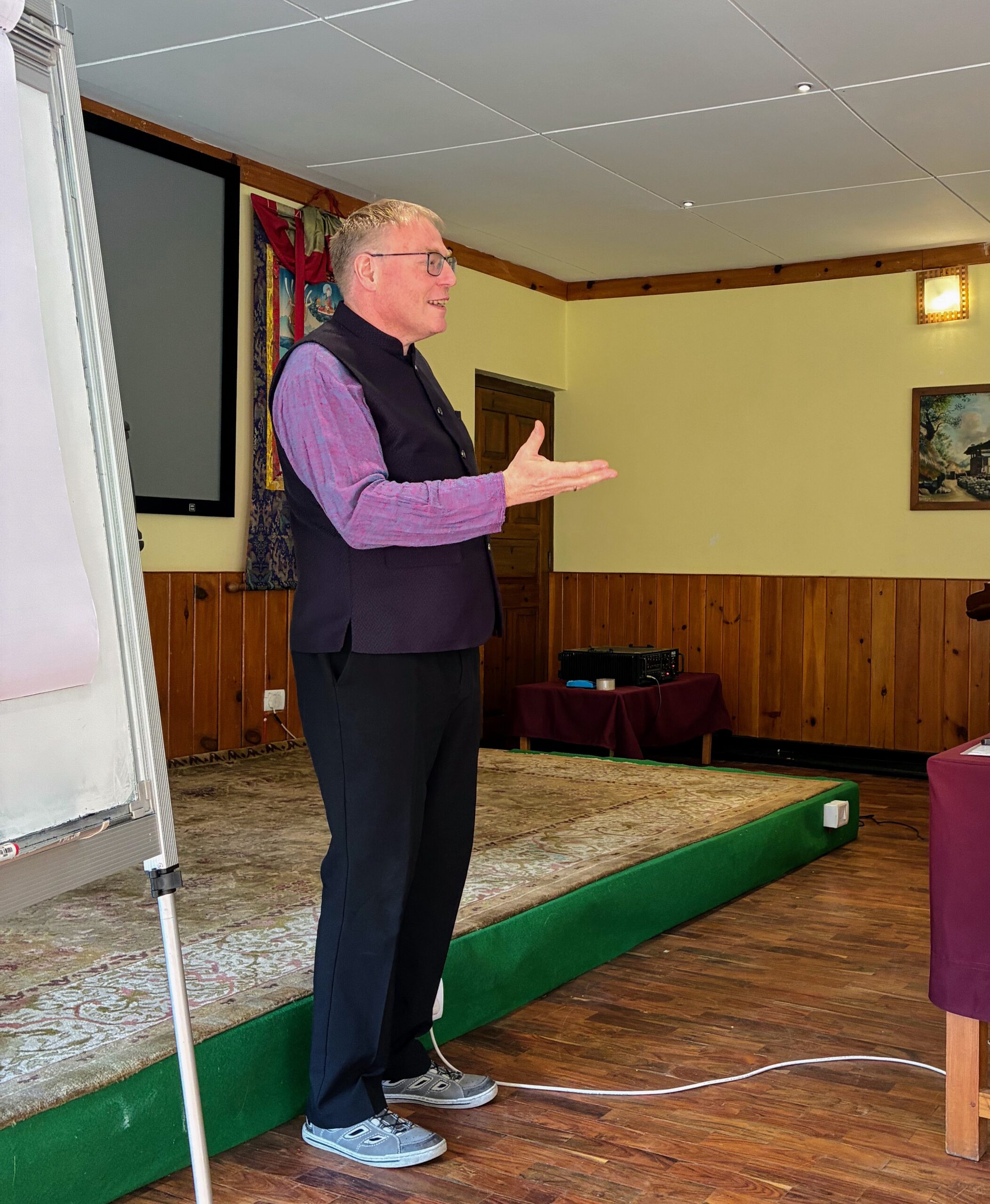
    By May, Liisa and I were at Kichu Resort in Paro, with the Himalayan foothills outside the window, about to deliver BilboConsult’s first international engagement.

    DTB Training Retreat 2026, Paro, Bhutan
    Kichu Resort, Paro, Bhutan — May 2026

    Who is DTB?

    Developer Tools Bhutan is the local entity of FIIT B.V., a Dutch software company. Their product, ComponentOne, is a UI component library used by enterprise development teams at Microsoft, IBM, IKEA, Tesla, Ford, ESPN, and Toshiba. The Paro team of 20–25 Bhutanese developers is technically excellent — and about to grow to 50, with 15 new joiners arriving soon.

    Managing Director Val gave me creative freedom and genuine trust from our very first conversation. That trust shaped everything that followed.

    The Sessions

    We designed two 75-minute interactive workshops, built around DTB’s own values and the team’s real challenges.

    Session 1 — “The Craft You Make Your Own”: Job Crafting

    Drawing on Amy Wrzesniewski and Jane Dutton’s research, this session explored three ways any developer can actively reshape their work: through the tasks they take on (task crafting), the relationships they build (relational crafting), and the perspective they bring to it (cognitive crafting). The session built on what DTB’s team had already learned in a 2025 session on clean code — which participants still referenced a year later. The question at its heart: how do you own the quality of your work, regardless of what’s on your ticket?

    Each participant left with a signed 30-day commitment card — one concrete thing they would do differently.

    Session 2 — “A Team Worth Joining”: Values in Action

    DTB has four written core values: Integrity, Innovation, Customer Success, and Community. Beautiful words. But what do they actually look like on a Tuesday afternoon, when you’re debugging at 4pm or welcoming a nervous new colleague on their first day?

    Working together, the team named the behaviours behind each value — the specific, concrete actions that bring these principles to life in daily work. The most tangible outcome: onboarding material for the 15 incoming developers, written entirely in the team’s own words. Authentic, grounded, theirs.

    We also opened a deliberate conversation about artificial intelligence — not as threat or hype, but as an innovation in service of quality, anchored in the values the team had just put into words together.

    The Experience

    DTB Training Retreat 2026, Paro, Bhutan
    DTB Training Retreat 2026 — Kichu Resort, Paro, Bhutan

    I was accompanied by my wife, Eeva-Liisa. Bhutan is not a typical business trip destination, and having her alongside made this a shared adventure as much as a professional engagement.

    The country does something to you. The philosophy of Gross National Happiness — measuring progress by the wellbeing of people, not only by economic output — turns out to be a perfect frame for conversations about craft and purpose. The team’s warmth, curiosity, and genuine commitment to each other made every session feel alive.

    What I valued most was the people themselves. This was not a team that needed to be built — they were already relational, already committed, already caring about their work. They needed permission and language to name what they were already doing well, and tools to take it intentionally further.

    What the Team Said

    The anonymous feedback cards from Session 2 told their own story. Participants described the retreat as insightful, exceptional, engaging, inspiring, fulfilling. They asked for more time, longer sessions, and more Q&A. One developer noted that the activities helped them “gain deeper insights into work they had previously considered mundane.” Another reflected on how meaningful it was to speak with international professionals “who were actually present when modern programming was born.”

    Val published the team’s own reflection on the retreat — “Cultivating Our Craft: Reflections on the 2026 DTB Training Retreat” — and described the session output as authentic onboarding material born directly from the team’s own words.

    Feedback specifically noted my “playful yet concrete activities” — a balance I care about deeply. Learning should be rigorous and enjoyable at the same time.

    What This Meant to Me

    This was BilboConsult’s first international engagement. But the significance went beyond that milestone.

    I have built this practice around a single purpose: to help people and teams develop their best selves — not through frameworks imposed from the outside, but through genuine conversation and discovery. Bhutan gave me the rare gift of living that purpose without compromise. I could focus entirely on people development. I could follow my curiosity across a completely new context. I could work across languages, cultures, and worldviews without once losing the thread of what matters.

    And I could do it with Liisa by my side.

    The title of this piece borrows from Tolkien — and from the name of this company, which is itself a nod to Bilbo Baggins, the reluctant adventurer who discovers that the journey he did not plan for turns out to be the one that defines him. It really was an unexpected journey. It really was an adventure. And it was one of the most successful and fulfilling things I have done as a consultant.

    What’s Next

    The relationship with DTB and FIIT continues. As the team grows toward 50, there are conversations about annual retreats, manager onboarding for the new cohort, and deeper work on the human side of software development. I’m looking forward to what comes next.

    And I’m grateful to Ilya for the unexpected phone call on an ordinary Finnish evening that started all of this.


    BilboConsult helps individuals, teams, and organisations find clarity about who they are and how they work — through facilitation, coaching, and leadership development. If your team is growing and you want to make sure the culture you’re building is worth joining, get in touch.

  • The Intentional Living Engine — Why Your Life Needs an Operating Model

    I’ve spent 40 years helping organisations design operating models — the systems, processes, and governance that make things actually work. A few months ago, I started applying the same thinking to my own life. Not because my life was broken, but because I kept noticing a pattern: I would have a good idea, make some progress, get busy, and then quietly move on to the next thing. The ideas were fine. The follow-through wasn’t.

    So I built what I now call an Intentional Living Engine. It’s an operating model for my life.

    What I Mean by Operating Model

    In IT management, an operating model answers a simple question: how does this organisation actually run? What processes exist, what systems support them, how does information flow, and who is responsible for what?

    A Personal Operating Model asks the same question about your life. It makes visible the systems you already have — whether you’ve named them or not — and the ones you’re missing. Where does your information live? What happens daily, weekly, monthly to keep things on track? What gets automated, what needs your judgment, and what needs a real conversation?

    Most of us have informal versions of this. A calendar. Some to-do lists. Maybe a journal. What I found is that making it explicit and intentional changed how I relate to my own commitments.

    Starting with Purpose, Not Tasks

    Here’s what I got wrong at first: I started with productivity. Better task management, more automation, smarter inbox processing. And those things matter — but they’re not the point.

    The point is purpose.

    For me, that purpose is rooted in faith. Living close to God. Being fully present with my wife, my family, my friends. Serving my community. The operating model exists to help me actually do those things consistently — not just think about them or plan to do them.

    But the framework works regardless of what your purpose is. The core question the system asks every day is the same: does what I’m doing today bring me closer to where I want to be?

    That’s a different question from “what do I need to get done today?” Productivity systems optimise for throughput — how many tasks can you check off. An Intentional Living Engine optimises for faithfulness — are you living the life you actually want?

    What I’ve Built

    After a few months of building, testing, and honestly also overbuilding, here’s what I’ve found matters. There are ten dimensions to a Personal Operating Model, and I’ll share the headlines here. I plan to write more about each one.

    Vision and purpose come first. Without clarity on what the system is for, it becomes a treadmill. I use a framework of four domains — Contemplation, Constitution, Community, and Craft — with a deliberate priority order. Faith and health before business.

    Life architecture means mapping out your areas of responsibility. I have 18, from faith and marriage to business development and household maintenance. Each gets regular attention through a weekly rotation. The upstream priorities get reviewed first. That’s not just organisation — it’s a statement of values written into a schedule.

    Information architecture is about having one place to look. My Obsidian vault is the index of my life. Not everything lives there, but everything is reachable from there. When I open my daily journal in the morning, I can see and reach every decision that needs my attention. At least, that’s the goal — making the links reliable is still a work in progress.

    Process architecture has three layers: a pipeline for mechanical data processing that runs invisibly, a cockpit (the daily journal) that presents information clearly, and a conversation layer — a morning standup with AI that doesn’t just list tasks but asks questions about what matters.

    Automation and AI strategy follows a simple principle: use the simplest technology that works. Deterministic scripts for routine processing. A local language model for classification tasks that need more intelligence than regex but less than a full conversation. And a frontier AI for the genuine dialogues — morning reflection, strategic thinking, the conversations where being challenged is the whole point.

    Technology choices matter less than you would think. What matters is that each component has a clear role, and when one piece is unavailable, the whole system degrades gracefully rather than breaking.

    Lifecycle tracking means that tasks, opportunities, and commitments each have defined states. The system doesn’t just tell me what’s new — it surfaces what’s stuck, what’s overdue, and what deserves to be celebrated.

    Review cadences give the system its rhythm. Daily for orientation. Weekly for feel and direction — how did it go? Monthly for data — what do the numbers say about health, finances, goal progress? Quarterly for strategy — am I doing the right things? Each cadence has a different character, and mixing them up makes them all less useful.

    Governance means the system itself gets maintained. Documentation is a first-class output. And there’s a question built into my monthly review that keeps me honest: is the system helping me achieve my goals, or am I just enjoying building it? Because building systems is fun, and that’s a legitimate risk.

    Human factors are the most important dimension. If I open the system with curiosity in the morning, it’s working. If I open it with dread, it’s not. Joy matters. The satisfaction of checking things off matters. A system you avoid is worse than no system at all.

    What I’ve Learned So Far

    Three things stand out.

    First, purpose before productivity. Every design decision gets tested against the question: does this help me live faithfully? Not “does this make me more efficient?” Efficiency in service of the wrong things is just faster drifting.

    Second, enterprise thinking works at personal scale — if you strip it down. I’m drawing on TOGAF, ITIL, Wardley Mapping, and GTD. Configuration management, capability mapping, service value streams — these are design patterns for complex systems, and your life is a complex system. But you have to be ruthless about what to keep and what to drop. Most enterprise architecture is overhead at a scale of one.

    Third, the biggest enemy is the good-idea cycle. New idea, burst of energy, initial progress, life gets busy, new idea replaces old one. The operating model’s job is to break that cycle — not by being rigid, but by making it visible. Here’s where you said you wanted to be. Here’s where you are. Here’s what changed and why. You decide — but with clear sight, not in the fog of busyness.

    Why I’m Sharing This

    I’m building this for myself, and I’m genuinely enjoying it. But I also notice that the methods and frameworks are not specific to me. The purpose is personal — yours will be different from mine. But the architecture of intentional living is universal.

    Over the coming months, I’ll share more about specific components: the daily journal as a life cockpit, the three-tier AI strategy, the review cadence framework, and the design principles that make the difference between a system you love and a system you abandon.

    If you’re someone who has plenty of good ideas but struggles to make them stick — or if you’ve tried productivity tools and found them useful but somehow not enough — I think you’ll find something here.


    Martin Kallenbach is an independent IT management consultant based in Helsinki. He helps organisations with transformation, service integration, and governance — and is currently applying the same thinking to the question of how to live well and intentionally.

    Get in touch at martin@bilboconsult.com or connect on LinkedIn.

  • April, May, and a lot of forward motion

    April and May are turning out to be months I’ll remember for a long time. A lot has happened, more is coming, and I’ve been bad at writing about any of it. So here’s the field report.

    VikingPLoP. Earlier this month I was in Jerisjärvi presenting my first academic paper — Finding Your First Client: A Pattern Language for Early-Stage Consulting Startups — at VikingPLoP 2026. After 40 years in the industry, writing an academic paper was genuinely new territory, and I found I enjoyed it. The conference itself brought together researchers and practitioners who take the craft of documenting patterns seriously, and the conversations were worth the journey. The paper is available here, and the pattern work will continue — I expect to develop it further in the coming weeks.

    Where BilboConsult is heading. The strategy has evolved considerably. AI governance and transformation — helping organisations move from AI adoption to actual AI-driven change — is the work I’m building toward. There’s a framing I came across recently that captures the problem well. George Sivulka, writing in a16z News, puts it this way: “AI just made every individual 10x more productive. No company became 10x more valuable as a result. Where did the productivity go?” That gap — between individual AI productivity and institutional transformation — is where the meaningful work is, and where real value can still be found. Most organisations I talk to are somewhere in the middle of exactly that gap.

    What’s ahead in May. The next few weeks are full and exciting. A few days in Lapland with old colleagues to kick things off. Then I’m travelling to deliver a leadership workshop at a company retreat — in Paro, Bhutan, which was something of a surprise development and is obviously super exciting. On the way, I’ll be stopping in Delhi for a day on each leg of the journey. Then back to Helsinki in time for a wedding in Tampere and a funeral — May holds both, and that’s just how life is sometimes.

    More coming soon. I have a piece in the pipeline on something I’ve been building quietly in the background — something that I think will resonate with more than a few of you.

  • From Reflection to Jerisjärvi — Presenting at VikingPLoP 2026

    Six months ago, I had never written an academic paper. I had never presented at a conference. And I had never started a company.

    That last one — founding BilboConsult — set the other two in motion. When my long-time friend Stefan Holtel invited me to submit to VikingPLoP, a conference on pattern languages, I hesitated. Pattern languages come from architecture and software engineering — rigorous, structured, peer-reviewed. I come from decades of doing the work, not writing about it.

    But I kept a reflection habit throughout the founding process, and the patterns kept surfacing. Problems I recognized. Solutions that worked — or didn’t. Forces pulling in opposite directions. So I started writing.

    The paper

    “Finding Your First Client: A Pattern Language for Early-Stage Consulting Startups” documents nine patterns across three phases — from establishing your market signal to landing that first paying engagement. At its heart is what I call the Consulting Credibility Bootstrap: the paradox of needing a track record to win clients while having no way to build one without them.

    What makes it unusual is that it’s a live field report. I wrote it while living through the patterns, not looking back on them. The paper includes real missteps, real pivots, and honest gaps where the outcome was still unknown at the time of writing.

    You can read the conference version here:

    Download the paper (PDF)

    Gratitude

    This paper would not exist without the people who shaped it.

    Rebecca Wirfs-Brock shepherded the paper through multiple revisions with patience, precision, and a gift for asking the questions I was avoiding. Stefan didn’t just convince me to write it — he walked alongside the entire process, from first outline to final edits.

    The sparring partners who stress-tested my thinking throughout the founding journey — Reetta, Teemu, Ville, Marko, Rob, Michael, Olli, Mathias, Mike, Nikke, Toomas, Pauliina, Edwin, and the wider Business Espoo community — will find their fingerprints throughout the patterns. Every honest conversation shaped the framework.

    And to everyone who read the peer review version in March and sent feedback: thank you. You made the paper better than I could have alone.

    What’s next

    This week I’m in Jerisjärvi to present the paper and participate in the writers’ workshops that are central to VikingPLoP. The process doesn’t end with the conference — it’s where the next round of refinement begins.

    If the patterns resonate with your own experience of starting something new, I would love to hear from you.

  • Finding Your First Client — An Academic Paper Born from a Real Consulting Launch

    I have never been a very academic person. I haven’t studied at university, and I haven’t published an academic paper before. Then again, until five months ago I had never started my own company either.

    But what I have always done is reflect on what I’m doing — thinking about the methodology, the patterns, and the lessons hidden inside the experience. So when a good friend invited me to join VikingPLoP, a conference on architectural patterns, an idea clicked: what if I turned the lessons from launching BilboConsult into a proper pattern language paper? My learning would become something other people could use too, and I would get to dig into the world of academic writing and pattern languages.

    From reflection to framework

    Pattern languages — a method that comes from architecture — describe recurring problems and their solutions as interconnected patterns. Instead of writing a business plan or a how-to guide, I chose to document what I was learning as nine interdependent patterns, each with the forces that pull in different directions, the solution I found, and honest reflection on what worked and what didn’t.

    The core problem the paper tackles is the Consulting Credibility Bootstrap: you need a track record to win clients, but you can’t build a track record without clients. That paradox defined my first months as an independent consultant — and it became the thread running through the entire paper.

    The nine patterns

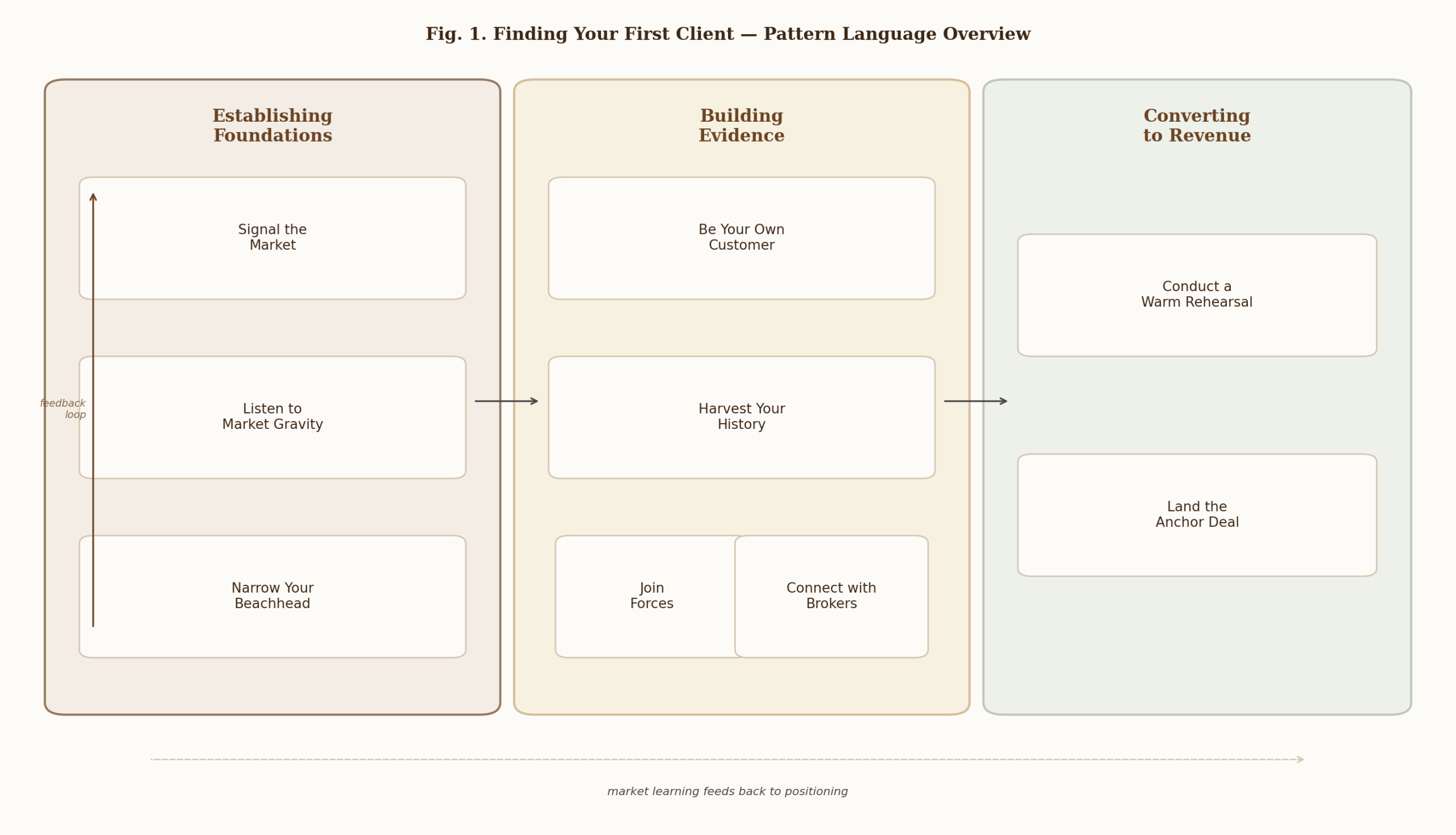
    Finding Your First Client — Pattern Language Overview showing nine patterns in three phases: Establishing Foundations, Building Evidence, and Converting to Revenue
    Fig. 1: Finding Your First Client — Pattern Language Overview

    The paper presents nine patterns organized in three phases:

    Establishing Foundations — Signal the Market, Listen to Market Gravity, Narrow Your Beachhead. These form a feedback loop: your signal generates market responses, those responses reveal where your real pull is, and that sharpens your positioning.

    Building Evidence — Be Your Own Customer, Harvest Your History, Join Forces, Connect with Brokers. Different strategies for building credibility when you don’t yet have consulting references.

    Converting to Revenue — Conduct a Warm Rehearsal, Land the Anchor Deal. Moving from conversations to contracts.

    The patterns aren’t a checklist. They work as a toolkit — you weave between them based on your situation.

    Signal types and what I learned

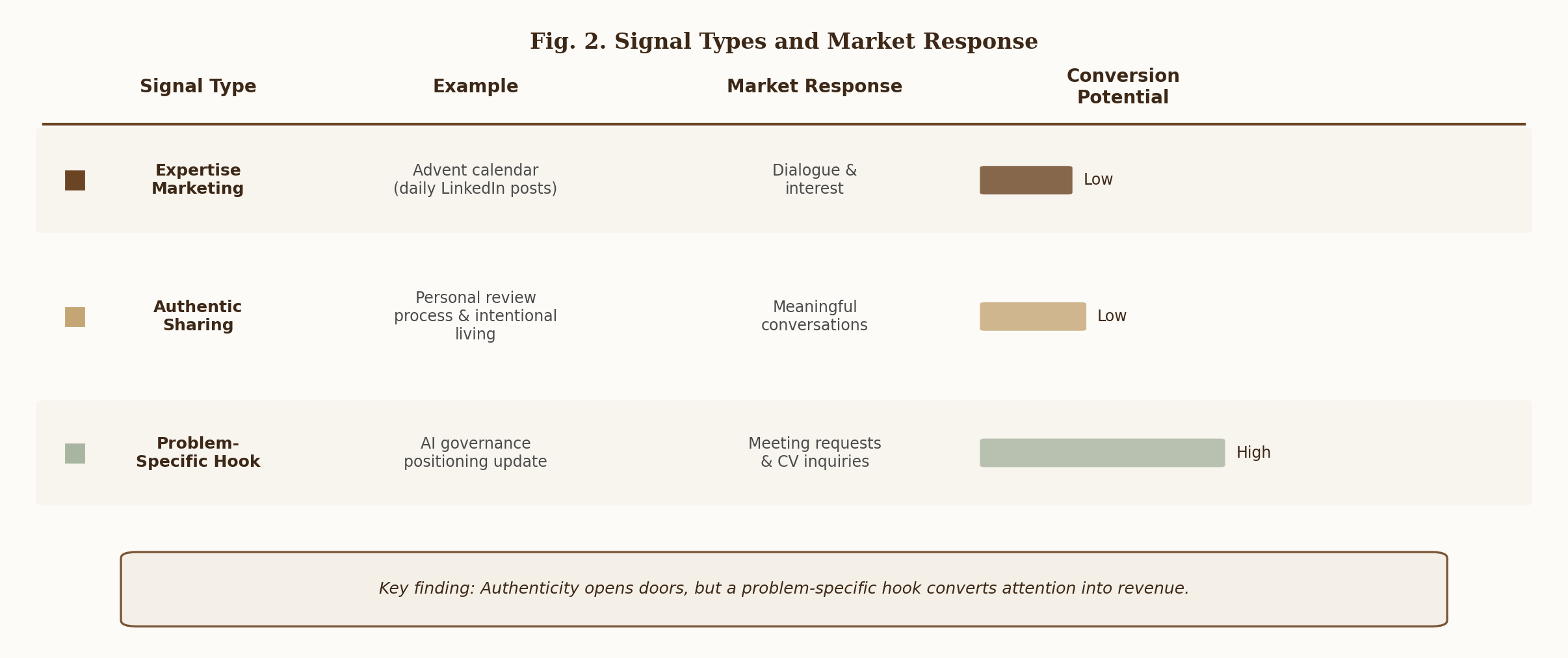
    Signal Types and Market Response matrix showing how different content strategies produced different market reactions
    Fig. 2: Signal Types and Market Response

    One of the most concrete findings: three distinct signal types produced measurably different responses. Authenticity beats self-marketing for building relationships, but mentioning a specific, urgent market problem is what converts attention into potential revenue. Both signal types matter — authenticity opens doors, but the problem-specific hook is what pulls prospects through them.

    The journey

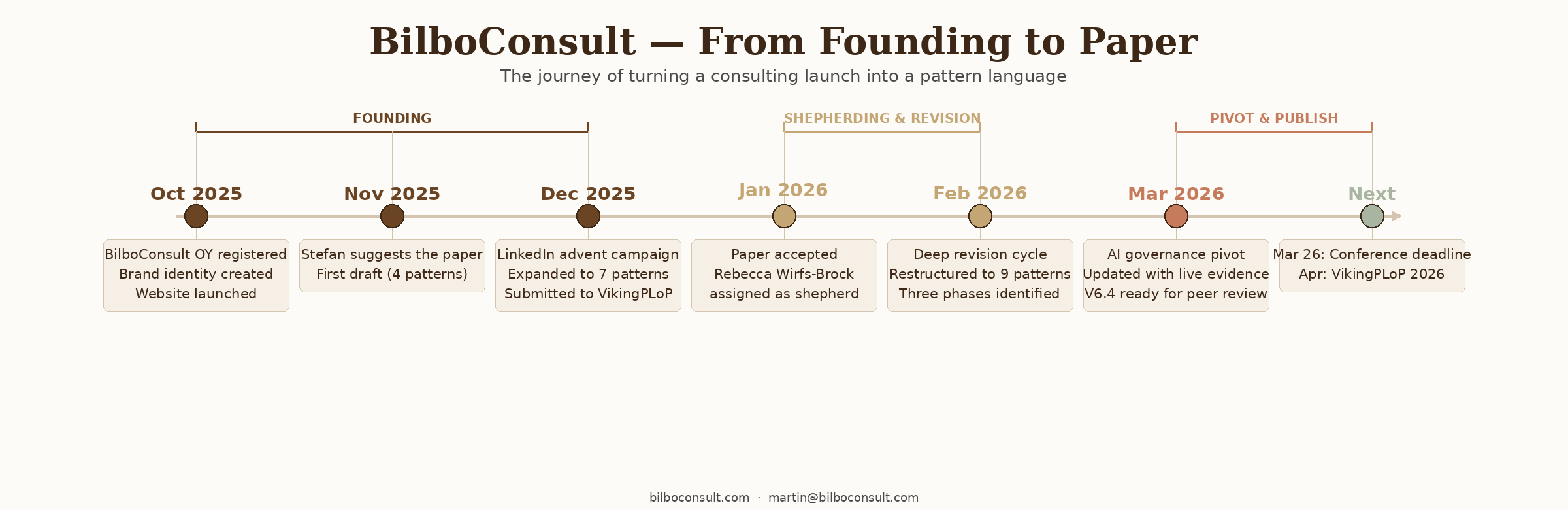
    Timeline showing BilboConsult's founding journey from October 2025 to March 2026
    BilboConsult journey: October 2025 – March 2026

    What makes this paper unusual for the academic world is that it’s a live field report. I’m not looking back on a successful journey — I’m writing from the middle of it. The paper documents real mistakes (like marketing to the wrong beachhead for two months because of confirmation bias), real pivots (narrowing from broad SIAM transformation to AI governance advisory), and patterns where the outcome is still unknown (I haven’t closed my first client yet, and the paper says so).

    Why I’m sharing this now

    The paper will be presented at VikingPLoP 2026 in April. The conference version deadline is March 26. Before submitting, I want to do something the academic process doesn’t always allow: open the paper to broader peer review.

    I’ve been fortunate to work with Rebecca Wirfs-Brock as my shepherd throughout the process. Her feedback has been invaluable. But a paper about consulting practice deserves feedback from other practitioners — people who’ve started practices, navigated the credibility gap, and built client relationships from scratch.

    The paper

    You can read the full paper here:

    Download: Finding Your First Client — A Pattern Language for Early-Stage Consulting Startups (PDF)

    Share your perspective — or join the peer review group

    The paper includes ten reviewer questions embedded throughout the text, designed to guide feedback on the patterns, the honesty of the narrative, and whether the framework resonates with real experience. But you don’t need to follow those — any perspective is welcome.

    If something rings true, tell me. If something feels off, I want to hear that too. A quick comment is just as valuable as a detailed review.

    For those who would like to go deeper, I’m forming a small peer review group of practitioners willing to read the paper and share structured feedback. This isn’t a formal academic review — it’s a conversation between people who’ve navigated similar terrain.

    What’s involved:

    • Read the paper (~8,000 words, 30-minute read)
    • Share your thoughts — on the embedded questions, or in your own way
    • Feedback by March 24 (so I can integrate it before the March 26 conference deadline)
    • You’ll be acknowledged in the paper’s acknowledgments section

    Interested? Send me a message at martin@bilboconsult.com or comment below. I’ll share the paper with commenting access so you can mark up directly.

    I’ll also be reaching out to a few trusted sparring partners directly, but the more diverse the perspectives, the stronger the paper becomes. If you’ve started a consulting practice, navigated a career transition into independent work, or simply have a practitioner’s eye for what rings true — I would value your input.


    Martin Kallenbach is an independent IT management consultant at BilboConsult OY, Helsinki. He brings four decades of transformation leadership across Cognizant, Tieto, HCL, Nokia, and AXA Tech to help organizations navigate complex IT governance challenges.

  • Starting a New Season

    Five months ago I registered BilboConsult as a company. At the time, I thought I was starting a business. I was wrong — or at least, I was thinking too small. What I’m actually doing is starting a new season of my life, and the business is just one part of it.

    Let me back up.

    I spent over forty years in IT management — at Nokia, Cognizant, Tieto, HCL, AXA Tech, and a handful of others. Big organizations, complex transformations, the kind of work where you spend years learning how to hold things together when everything wants to fall apart. Crisis management, service integration, governance. I got good at it. I loved it.

    Then last year, at sixty, I decided to do something I had always thought about but never quite dared: build something of my own.

    The honest version

    I could write the polished version of this story — the one where I had a clear vision from day one, executed a brilliant strategy, and here we are. But that’s not what happened.

    The first few months of BilboConsult were messy. I built a website. I wrote a go-to-market plan. I networked. I studied frameworks and positioning and all the things you’re supposed to do. Some of it was useful. Much of it came too early. I was moving fast without being clear about where I was actually going.

    So in early March, I did what I would advise any client to do: I stopped, took an honest look at what was working and what wasn’t, and made a deliberate pivot.

    What changed

    The pivot wasn’t dramatic from the outside, but it was clarifying from the inside. Instead of trying to be everything — fractional CIO, SIAM consultant, transformation advisor — I asked a simpler question: where does my forty years of governance experience meet the most urgent market need right now?

    The answer turned out to be AI governance.

    Not the technology side of AI — there are plenty of brilliant people working on models and algorithms. But the governance side: risk management, human oversight, documentation, incident response, compliance frameworks. The EU AI Act lands in August, and most organizations are treating it as a technology problem. It’s not. It’s a governance problem. And governance is what I’ve been practicing my entire career.

    That realization sharpened everything. The positioning, the partnerships I’m developing, the content I want to create — it all started to align.

    What else is growing

    But here’s the thing about starting a new season: it’s not only about work.

    I’m learning Finnish. Not conversational Finnish picked up over coffee — I’m in an actual classroom, at A1 level, stumbling through verb conjugations alongside people half my age. It’s humbling in the best way. There’s something about being a genuine beginner again that resets your relationship with competence. You can’t hide behind expertise when you can barely order lunch.

    I’m also writing an academic paper. It’s for VikingPLoP, a pattern language conference, and it documents patterns for experienced professionals starting a consulting practice. The strange thing about writing an academic paper on your own live experiment is that you can’t hide behind theory — the results are unfolding in real time, and the paper has to be honest about that.

    And I’m working with AI in ways I didn’t expect. Not just studying AI governance — actually using AI tools as a daily operating partner. Building systems, writing, thinking, planning. It’s changed how I work, and it’s given me a practitioner’s perspective that most governance consultants don’t have.

    Slow is fine

    None of this is happening fast. BilboConsult is pre-revenue. The partnerships I’m building are in early conversations. The Finnish course runs through June. The paper isn’t submitted yet.

    A few months ago, that slowness would have bothered me. I would have seen it as falling behind. Now I see it differently: things are taking root. The direction is right. The foundations are solid. And I would rather build something real than rush something hollow.

    I named the company after Bilbo Baggins for a reason. Not because of the adventure — because of the unexpected journey. The one where you leave your comfortable life, discover capabilities you didn’t know you had, and come back transformed. The journey matters more than the speed.

    What to expect from this space

    This is my first post here, but it won’t be the last. I’ll be writing about AI governance — what the EU AI Act actually requires, how existing governance frameworks map to it, and what organizations should be doing now. I’ll share what I’m learning, both professionally and personally. And I’ll be honest about the journey: what works, what doesn’t, and what I’m figuring out along the way.

    If you’re navigating a similar transition — whether it’s starting something new, finding your footing after decades in corporate life, or trying to make sense of the AI governance landscape — I would love to hear from you.

    The season is just beginning.


    Martin Kallenbach is the founder of BilboConsult, an independent IT management consultancy based in Helsinki, Finland. He brings over forty years of experience in IT governance, service integration, and organizational transformation.