Tag: consulting

  • The Intentional Living Engine — Why Your Life Needs an Operating Model

    I’ve spent 40 years helping organisations design operating models — the systems, processes, and governance that make things actually work. A few months ago, I started applying the same thinking to my own life. Not because my life was broken, but because I kept noticing a pattern: I’d have a good idea, make some progress, get busy, and then quietly move on to the next thing. The ideas were fine. The follow-through wasn’t.

    So I built what I now call an Intentional Living Engine. It’s an operating model for my life.

    What I Mean by Operating Model

    In IT management, an operating model answers a straightforward question: how does this organisation actually run? What processes exist, what systems support them, how does information flow, and who is responsible for what?

    A Personal Operating Model asks the same question about your life. It makes visible the systems you already have — whether you’ve named them or not — and the ones you’re missing. Where does your information live? What happens daily, weekly, monthly to keep things on track? What gets automated, what needs your judgment, and what needs a real conversation?

    Most of us have informal versions of this. A calendar. Some to-do lists. Maybe a journal. What I found is that making it explicit and intentional changed how I relate to my own commitments.

    Starting with Purpose, Not Tasks

    Here’s what I got wrong at first: I started with productivity. Better task management, more automation, smarter inbox processing. And those things matter — but they’re not the point.

    The point is purpose.

    For me, that purpose is rooted in faith. Living close to God. Being fully present with my wife, my family, my friends. Serving my community. The operating model exists to help me actually do those things consistently — not just think about them or plan to do them.

    But the framework works regardless of what your purpose is. The core question the system asks every day is the same: does what I’m doing today bring me closer to where I want to be?

    That’s a different question from “what do I need to get done today?” Productivity systems optimise for throughput — how many tasks can you check off. An Intentional Living Engine optimises for faithfulness — are you living the life you actually want?

    What I’ve Built

    After a few months of building, testing, and honestly also overbuilding, here’s what I’ve found matters. There are ten dimensions to a Personal Operating Model, and I’ll share the headlines here. I plan to write more about each one.

    Vision and purpose come first. Without clarity on what the system is for, it becomes a treadmill. I use a framework of four domains — Contemplation, Constitution, Community, and Craft — with a deliberate priority order. Faith and health before business.

    Life architecture means mapping out your areas of responsibility. I have 18, from faith and marriage to business development and household maintenance. Each gets regular attention through a weekly rotation. The upstream priorities get reviewed first. That’s not just organisation — it’s a statement of values encoded in a schedule.

    Information architecture is about having one place to look. My Obsidian vault is the index of my life. Not everything lives there, but everything is reachable from there. When I open my daily journal in the morning, I can see and reach every decision that needs my attention. At least, that’s the goal — making the links reliable is still a work in progress.

    Process architecture has three layers: a pipeline for mechanical data processing that runs invisibly, a cockpit (the daily journal) that presents information clearly, and a conversation layer — a morning standup with AI that doesn’t just list tasks but asks questions about what matters.

    Automation and AI strategy follows a simple principle: use the simplest technology that works. Deterministic scripts for routine processing. A local language model for classification tasks that need more intelligence than regex but less than a full conversation. And a frontier AI for the genuine dialogues — morning reflection, strategic thinking, the conversations where being challenged is the whole point.

    Technology choices matter less than you’d think. What matters is that each component has a clear role, and when one piece is unavailable, the whole system degrades gracefully rather than breaking.

    Lifecycle tracking means that tasks, opportunities, and commitments each have defined states. The system doesn’t just tell me what’s new — it surfaces what’s stuck, what’s overdue, and what deserves to be celebrated.

    Review cadences give the system its rhythm. Daily for orientation. Weekly for feel and direction — how did it go? Monthly for data — what do the numbers say about health, finances, goal progress? Quarterly for strategy — am I doing the right things? Each cadence has a different character, and mixing them up makes them all less useful.

    Governance means the system itself gets maintained. Documentation is a first-class output. And there’s a question built into my monthly review that keeps me honest: is the system helping me achieve my goals, or am I just enjoying building it? Because building systems is fun, and that’s a legitimate risk.

    Human factors are the most important dimension. If I open the system with curiosity in the morning, it’s working. If I open it with dread, it’s not. Joy matters. The satisfaction of checking things off matters. A system you avoid is worse than no system at all.

    What I’ve Learned So Far

    Three things stand out.

    First, purpose before productivity. Every design decision gets tested against the question: does this help me live faithfully? Not “does this make me more efficient?” Efficiency in service of the wrong things is just faster drifting.

    Second, enterprise thinking works at personal scale — if you strip it down. I’m drawing on TOGAF, ITIL, Wardley Mapping, and GTD. Configuration management, capability mapping, service value streams — these are design patterns for complex systems, and your life is a complex system. But you have to be ruthless about what to keep and what to drop. Most enterprise architecture is overhead at a scale of one.

    Third, the biggest enemy is the good-idea cycle. New idea, burst of energy, initial progress, life gets busy, new idea replaces old one. The operating model’s job is to break that cycle — not by being rigid, but by making it visible. Here’s where you said you wanted to be. Here’s where you are. Here’s what changed and why. You decide — but with clear sight, not in the fog of busyness.

    Why I’m Sharing This

    I’m building this for myself, and I’m genuinely enjoying it. But I also notice that the methods and frameworks are not specific to me. The purpose is personal — yours will be different from mine. But the architecture of intentional living is universal.

    Over the coming months, I’ll share more about specific components: the daily journal as a life cockpit, the three-tier AI strategy, the review cadence framework, and the design principles that make the difference between a system you love and a system you abandon.

    If you’re someone who has plenty of good ideas but struggles to make them stick — or if you’ve tried productivity tools and found them useful but somehow not enough — I think you’ll find something here.


    Martin Kallenbach is an independent IT management consultant based in Helsinki. He helps organisations with transformation, service integration, and governance — and is currently applying the same thinking to the question of how to live well and intentionally.

    Get in touch at martin@bilboconsult.com or connect on LinkedIn.

  • April, May, and a lot of forward motion

    April and May are turning out to be months I’ll remember for a long time. A lot has happened, more is coming, and I’ve been bad at writing about any of it. So here’s the field report.

    VikingPLoP. Earlier this month I was in Jerisjärvi presenting my first academic paper — Finding Your First Client: A Pattern Language for Early-Stage Consulting Startups — at VikingPLoP 2026. After 40 years in the industry, writing an academic paper was genuinely new territory, and I found I enjoyed it. The conference itself brought together researchers and practitioners who take the craft of documenting patterns seriously, and the conversations were worth the journey. The paper is available here, and the pattern work will continue — I expect to develop it further in the coming weeks.

    Where BilboConsult is heading. The strategy has evolved considerably. AI governance and transformation — helping organisations move from AI adoption to actual AI-driven change — is the work I’m building toward. There’s a framing I came across recently that captures the problem well. George Sivulka, writing in a16z News, puts it this way: “AI just made every individual 10x more productive. No company became 10x more valuable as a result. Where did the productivity go?” That gap — between individual AI productivity and institutional transformation — is where the meaningful work is, and where real value can still be found. Most organisations I talk to are somewhere in the middle of exactly that gap.

    What’s ahead in May. The next few weeks are full and exciting. A few days in Lapland with old colleagues to kick things off. Then I’m travelling to deliver a leadership workshop at a company retreat — in Paro, Bhutan, which was something of a surprise development and is obviously super exciting. En route, I’ll be stopping in Delhi for a day on each leg of the journey. Then back to Helsinki in time for a wedding in Tampere and a funeral — May holds both, and that’s just how life is sometimes.

    More coming soon. I have a piece in the pipeline on something I’ve been building quietly in the background — something that I think will resonate with more than a few of you.

  • From Reflection to Jerisjärvi — Presenting at VikingPLoP 2026

    Six months ago, I had never written an academic paper. I had never presented at a conference. And I had never started a company.

    That last one — founding BilboConsult — set the other two in motion. When my long-time friend Stefan Holtel invited me to submit to VikingPLoP, a conference on pattern languages, I hesitated. Pattern languages come from architecture and software engineering — rigorous, structured, peer-reviewed. I come from decades of doing the work, not writing about it.

    But I kept a reflection habit throughout the founding process, and the patterns kept surfacing. Problems I recognized. Solutions that worked — or didn’t. Forces pulling in opposite directions. So I started writing.

    The paper

    “Finding Your First Client: A Pattern Language for Early-Stage Consulting Startups” documents nine patterns across three phases — from establishing your market signal to landing that first paying engagement. At its heart is what I call the Consulting Credibility Bootstrap: the paradox of needing a track record to win clients while having no way to build one without them.

    What makes it unusual is that it’s a live field report. I wrote it while living through the patterns, not looking back on them. The paper includes real missteps, real pivots, and honest gaps where the outcome was still unknown at the time of writing.

    You can read the conference version here:

    Download the paper (PDF)

    Gratitude

    This paper would not exist without the people who shaped it.

    Rebecca Wirfs-Brock shepherded the paper through multiple revisions with patience, precision, and a gift for asking the questions I was avoiding. Stefan didn’t just convince me to write it — he walked alongside the entire process, from first outline to final edits.

    The sparring partners who stress-tested my thinking throughout the founding journey — Reetta, Teemu, Ville, Marko, Rob, Michael, Olli, Mathias, Mike, Nikke, Toomas, Pauliina, Edwin, and the wider Business Espoo community — will find their fingerprints throughout the patterns. Every honest conversation shaped the framework.

    And to everyone who read the peer review version in March and sent feedback: thank you. You made the paper better than I could have alone.

    What’s next

    This week I’m in Jerisjärvi to present the paper and participate in the writers’ workshops that are central to VikingPLoP. The process doesn’t end with the conference — it’s where the next round of refinement begins.

    If the patterns resonate with your own experience of starting something new, I’d love to hear from you.

  • Finding Your First Client — An Academic Paper Born from a Real Consulting Launch

    I have never been a very academic person. I haven’t studied at university, and I haven’t published an academic paper before. Then again, until five months ago I also had never started my own company either.

    But what I have always done is reflect on what I’m doing — thinking about the methodology, the patterns, and the lessons hidden inside the experience. So when a good friend invited me to join VikingPLoP, a conference on architectural patterns, an idea clicked: what if I turned the lessons from launching BilboConsult into a proper pattern language paper? My learning becoming something other people can use too, and I also dig into the world of academic writing and pattern languages.

    From reflection to framework

    Pattern languages — a method originating from architecture — describe recurring problems and their solutions as interconnected patterns. Instead of writing a business plan or a how-to guide, I chose to document what I was learning as nine interdependent patterns, each with the forces that pull in different directions, the solution I found, and honest reflection on what worked and what didn’t.

    The core problem the paper tackles is the Consulting Credibility Bootstrap: you need a track record to win clients, but you can’t build a track record without clients. That paradox defined my first months as an independent consultant — and it became the thread running through the entire paper.

    The nine patterns

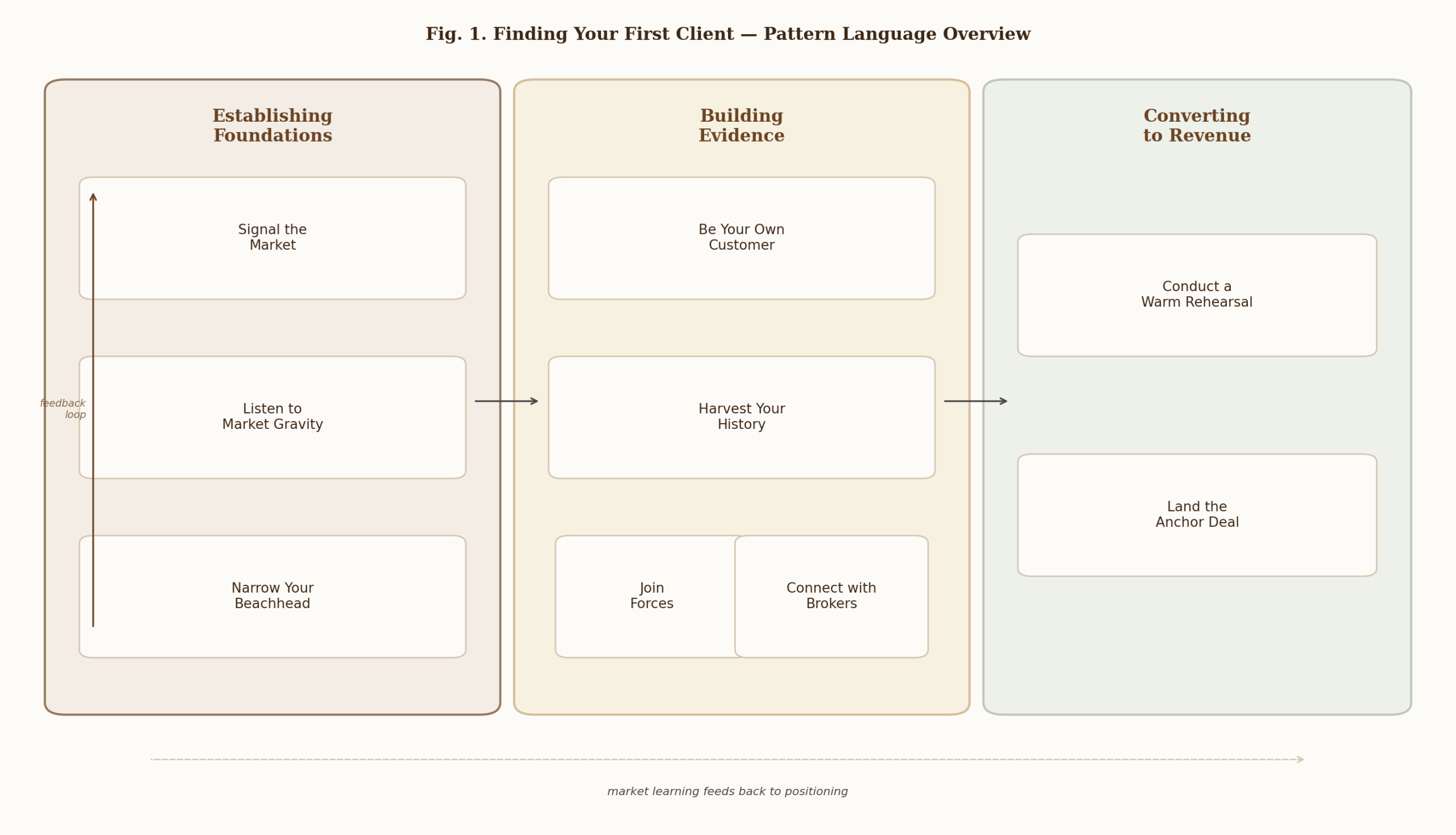
    Finding Your First Client — Pattern Language Overview showing nine patterns in three phases: Establishing Foundations, Building Evidence, and Converting to Revenue
    Fig. 1: Finding Your First Client — Pattern Language Overview

    The paper presents nine patterns organized in three phases:

    Establishing Foundations — Signal the Market, Listen to Market Gravity, Narrow Your Beachhead. These form a feedback loop: your signal generates market responses, those responses reveal where your real pull is, and that sharpens your positioning.

    Building Evidence — Be Your Own Customer, Harvest Your History, Join Forces, Connect with Brokers. Different strategies for building credibility when you don’t yet have consulting references.

    Converting to Revenue — Conduct a Warm Rehearsal, Land the Anchor Deal. Moving from conversations to contracts.

    The patterns aren’t a checklist. They work as a toolkit — you weave between them based on your situation.

    Signal types and what I learned

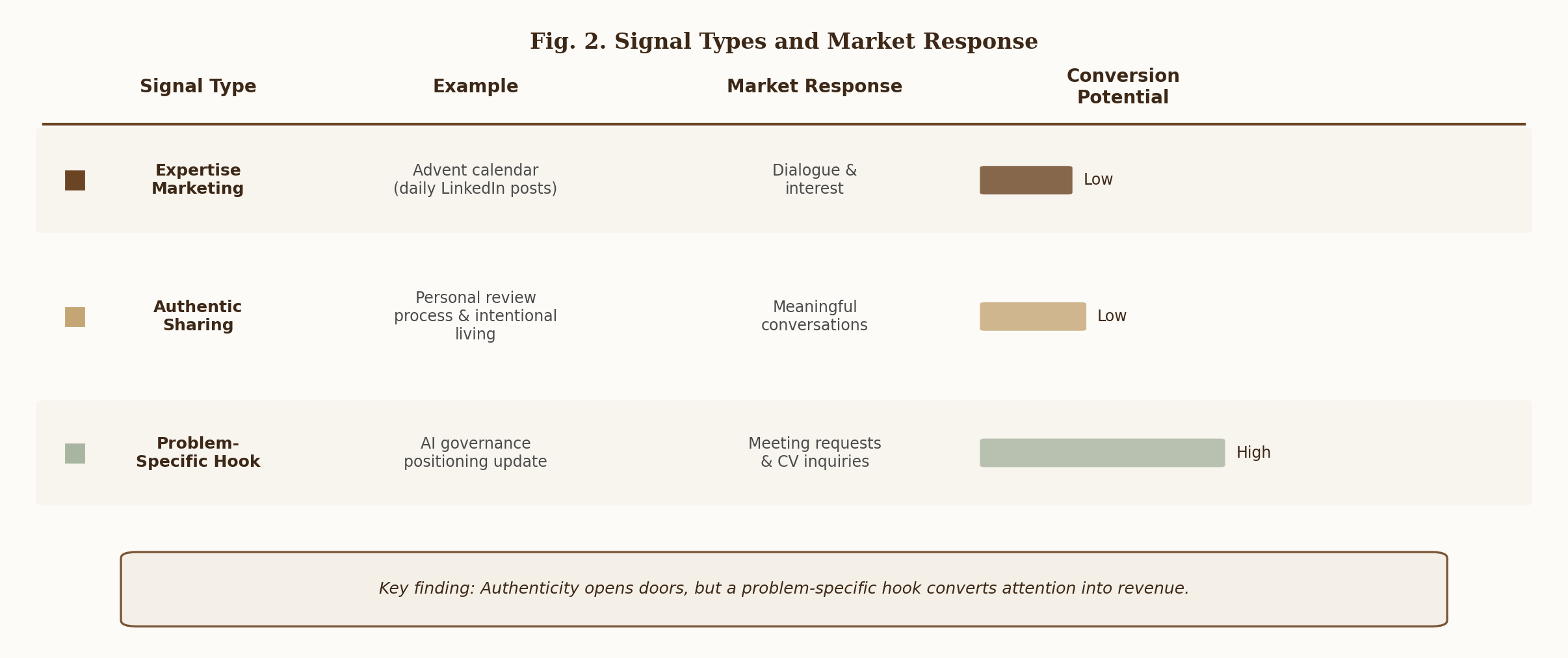
    Signal Types and Market Response matrix showing how different content strategies produced different market reactions
    Fig. 2: Signal Types and Market Response

    One of the most concrete findings: three distinct signal types produced measurably different responses. Authenticity beats self-marketing for building relationships, but mentioning a specific, urgent market problem is what converts attention into potential revenue. Both signal types matter — authenticity opens doors, but the problem-specific hook is what pulls prospects through them.

    The journey

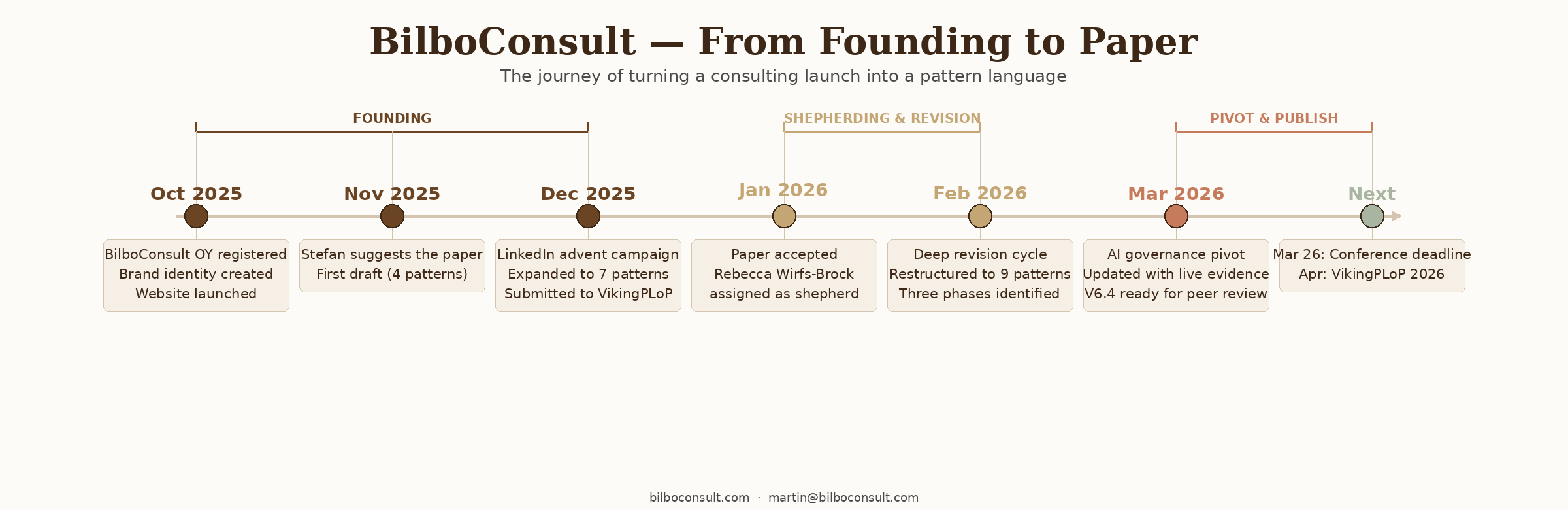
    Timeline showing BilboConsult's founding journey from October 2025 to March 2026
    BilboConsult journey: October 2025 – March 2026

    What makes this paper unusual for the academic world is that it’s a live field report. I’m not looking back on a successful journey — I’m writing from the middle of it. The paper documents real mistakes (like marketing to the wrong beachhead for two months because of confirmation bias), real pivots (narrowing from broad SIAM transformation to AI governance advisory), and patterns where the outcome is still unknown (I haven’t closed my first client yet, and the paper says so).

    Why I’m sharing this now

    The paper will be presented at VikingPLoP 2026 in April. The conference version deadline is March 26. Before submitting, I want to do something the academic process doesn’t always allow: open the paper to broader peer review.

    I’ve been fortunate to work with Rebecca Wirfs-Brock as my shepherd throughout the process. Her feedback has been invaluable. But a paper about consulting practice deserves feedback from other practitioners — people who’ve started practices, navigated the credibility gap, and built client relationships from scratch.

    The paper

    You can read the full paper here:

    Download: Finding Your First Client — A Pattern Language for Early-Stage Consulting Startups (PDF)

    Share your perspective — or join the peer review group

    The paper includes ten reviewer questions embedded throughout the text, designed to guide feedback on the patterns, the honesty of the narrative, and whether the framework resonates with real experience. But you don’t need to follow those — any perspective is welcome.

    If something rings true, tell me. If something feels off, I want to hear that too. A quick comment is just as valuable as a detailed review.

    For those who’d like to go deeper, I’m forming a small peer review group of practitioners willing to read the paper and share structured feedback. This isn’t a formal academic review — it’s a conversation between people who’ve navigated similar terrain.

    What’s involved:

    • Read the paper (~8,000 words, 30-minute read)
    • Share your thoughts — on the embedded questions, or in your own way
    • Feedback by March 24 (so I can integrate it before the March 26 conference deadline)
    • You’ll be acknowledged in the paper’s acknowledgments section

    Interested? Send me a message at martin@bilboconsult.com or comment below. I’ll share the paper with commenting access so you can mark up directly.

    I’ll also be reaching out to a few trusted sparring partners directly, but the more diverse the perspectives, the stronger the paper becomes. If you’ve started a consulting practice, navigated a career transition into independent work, or simply have a practitioner’s eye for what rings true — I’d value your input.


    Martin Kallenbach is an independent IT management consultant at BilboConsult OY, Helsinki. He brings four decades of transformation leadership across Cognizant, Tieto, HCL, Nokia, and AXA Tech to help organizations navigate complex IT governance challenges.

© 2026 BilboConsult. All rights reserved.  |  Privacy Policy