Six months ago, I had never written an academic paper. I had never presented at a conference. And I had never started a company.
That last one — founding BilboConsult — set the other two in motion. When my long-time friend Stefan Holtel invited me to submit to VikingPLoP, a conference on pattern languages, I hesitated. Pattern languages come from architecture and software engineering — rigorous, structured, peer-reviewed. I come from decades of doing the work, not writing about it.
But I kept a reflection habit throughout the founding process, and the patterns kept surfacing. Problems I recognized. Solutions that worked — or didn’t. Forces pulling in opposite directions. So I started writing.
The paper
“Finding Your First Client: A Pattern Language for Early-Stage Consulting Startups” documents nine patterns across three phases — from establishing your market signal to landing that first paying engagement. At its heart is what I call the Consulting Credibility Bootstrap: the paradox of needing a track record to win clients while having no way to build one without them.
What makes it unusual is that it’s a live field report. I wrote it while living through the patterns, not looking back on them. The paper includes real missteps, real pivots, and honest gaps where the outcome was still unknown at the time of writing.
This paper would not exist without the people who shaped it.
Rebecca Wirfs-Brock shepherded the paper through multiple revisions with patience, precision, and a gift for asking the questions I was avoiding. Stefan didn’t just convince me to write it — he walked alongside the entire process, from first outline to final edits.
The sparring partners who stress-tested my thinking throughout the founding journey — Reetta, Teemu, Ville, Marko, Rob, Michael, Olli, Mathias, Mike, Nikke, Toomas, Pauliina, Edwin, and the wider Business Espoo community — will find their fingerprints throughout the patterns. Every honest conversation shaped the framework.
And to everyone who read the peer review version in March and sent feedback: thank you. You made the paper better than I could have alone.
What’s next
This week I’m in Jerisjärvi to present the paper and participate in the writers’ workshops that are central to VikingPLoP. The process doesn’t end with the conference — it’s where the next round of refinement begins.
If the patterns resonate with your own experience of starting something new, I would love to hear from you.
I have never been a very academic person. I haven’t studied at university, and I haven’t published an academic paper before. Then again, until five months ago I had never started my own company either.
But what I have always done is reflect on what I’m doing — thinking about the methodology, the patterns, and the lessons hidden inside the experience. So when a good friend invited me to join VikingPLoP, a conference on architectural patterns, an idea clicked: what if I turned the lessons from launching BilboConsult into a proper pattern language paper? My learning would become something other people could use too, and I would get to dig into the world of academic writing and pattern languages.
From reflection to framework
Pattern languages — a method that comes from architecture — describe recurring problems and their solutions as interconnected patterns. Instead of writing a business plan or a how-to guide, I chose to document what I was learning as nine interdependent patterns, each with the forces that pull in different directions, the solution I found, and honest reflection on what worked and what didn’t.
The core problem the paper tackles is the Consulting Credibility Bootstrap: you need a track record to win clients, but you can’t build a track record without clients. That paradox defined my first months as an independent consultant — and it became the thread running through the entire paper.
The nine patterns
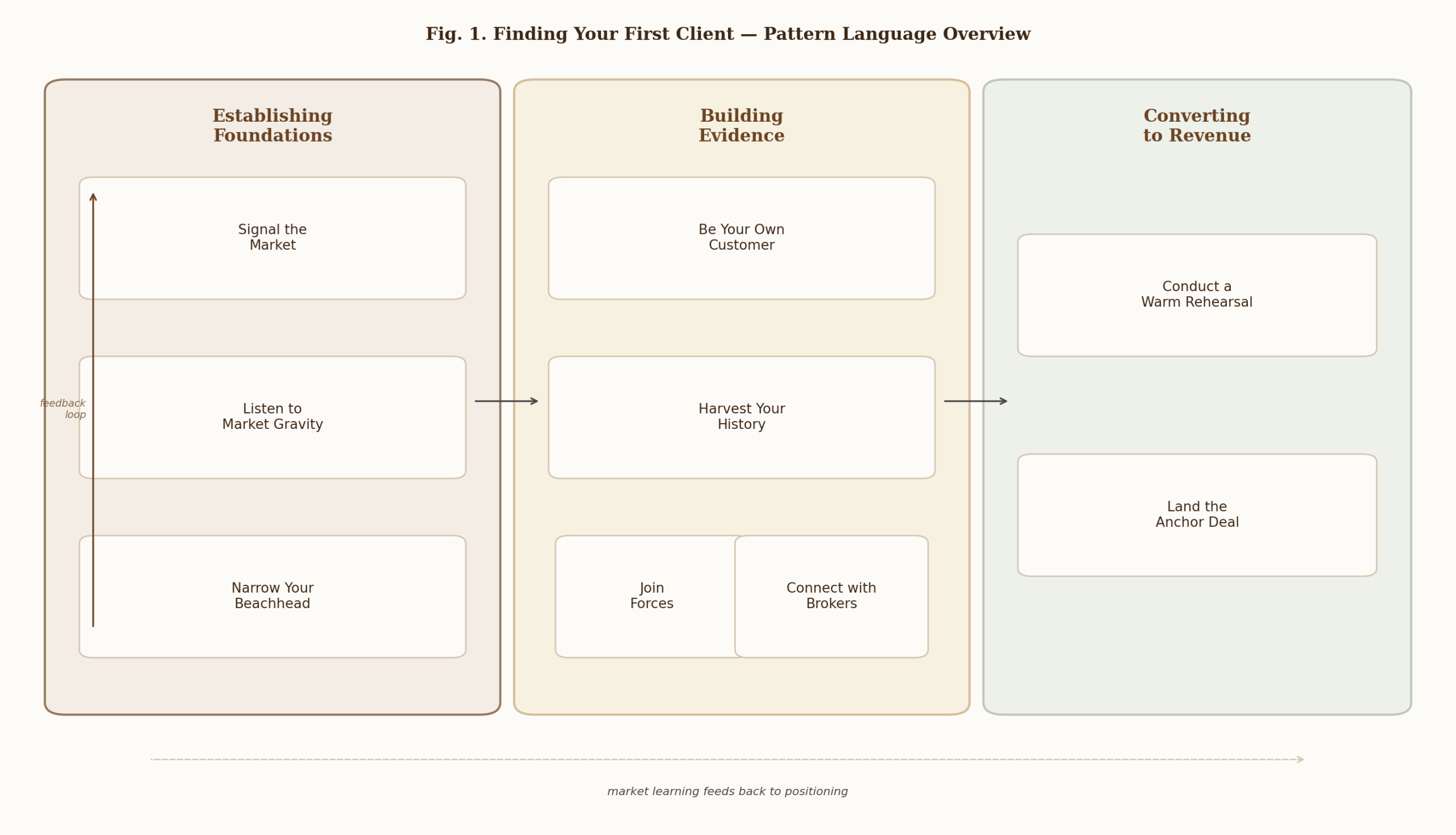
Fig. 1: Finding Your First Client — Pattern Language Overview
The paper presents nine patterns organized in three phases:
Establishing Foundations — Signal the Market, Listen to Market Gravity, Narrow Your Beachhead. These form a feedback loop: your signal generates market responses, those responses reveal where your real pull is, and that sharpens your positioning.
Building Evidence — Be Your Own Customer, Harvest Your History, Join Forces, Connect with Brokers. Different strategies for building credibility when you don’t yet have consulting references.
Converting to Revenue — Conduct a Warm Rehearsal, Land the Anchor Deal. Moving from conversations to contracts.
The patterns aren’t a checklist. They work as a toolkit — you weave between them based on your situation.
Signal types and what I learned
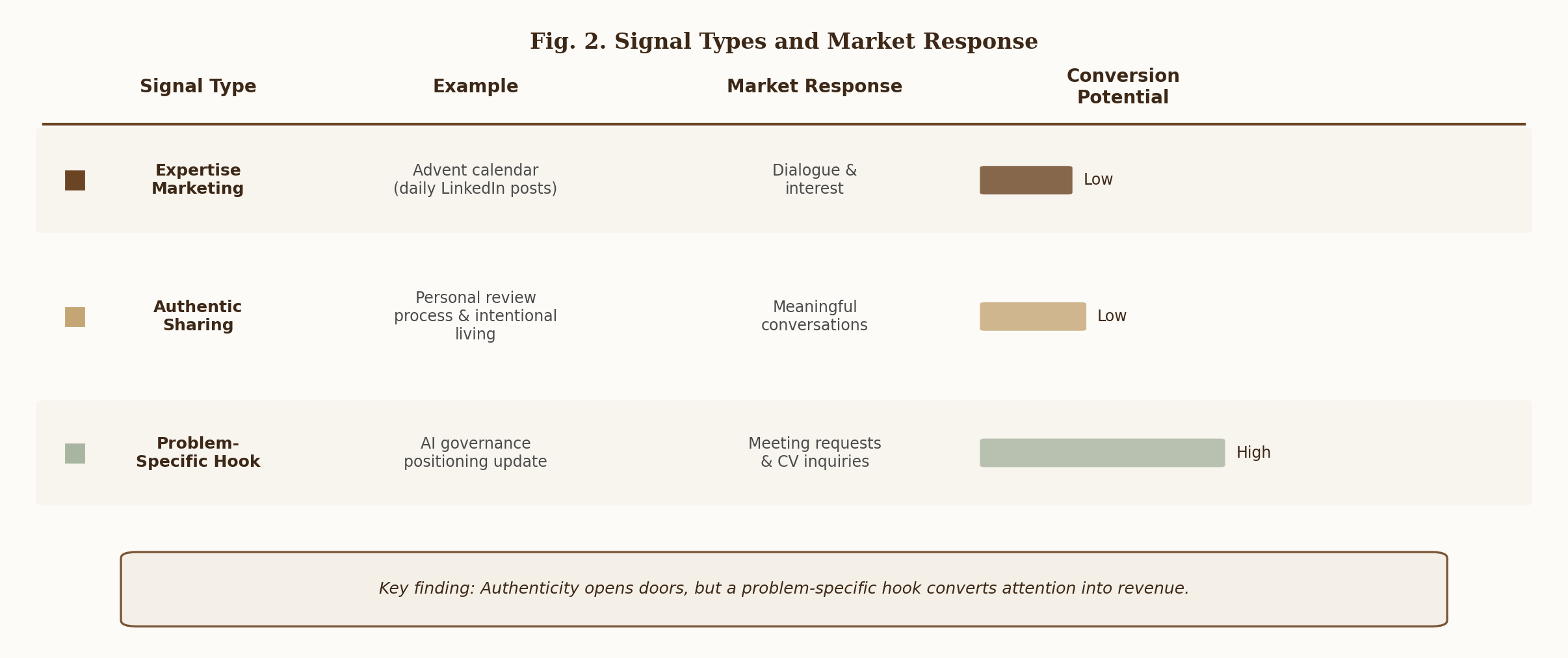
Fig. 2: Signal Types and Market Response
One of the most concrete findings: three distinct signal types produced measurably different responses. Authenticity beats self-marketing for building relationships, but mentioning a specific, urgent market problem is what converts attention into potential revenue. Both signal types matter — authenticity opens doors, but the problem-specific hook is what pulls prospects through them.
The journey
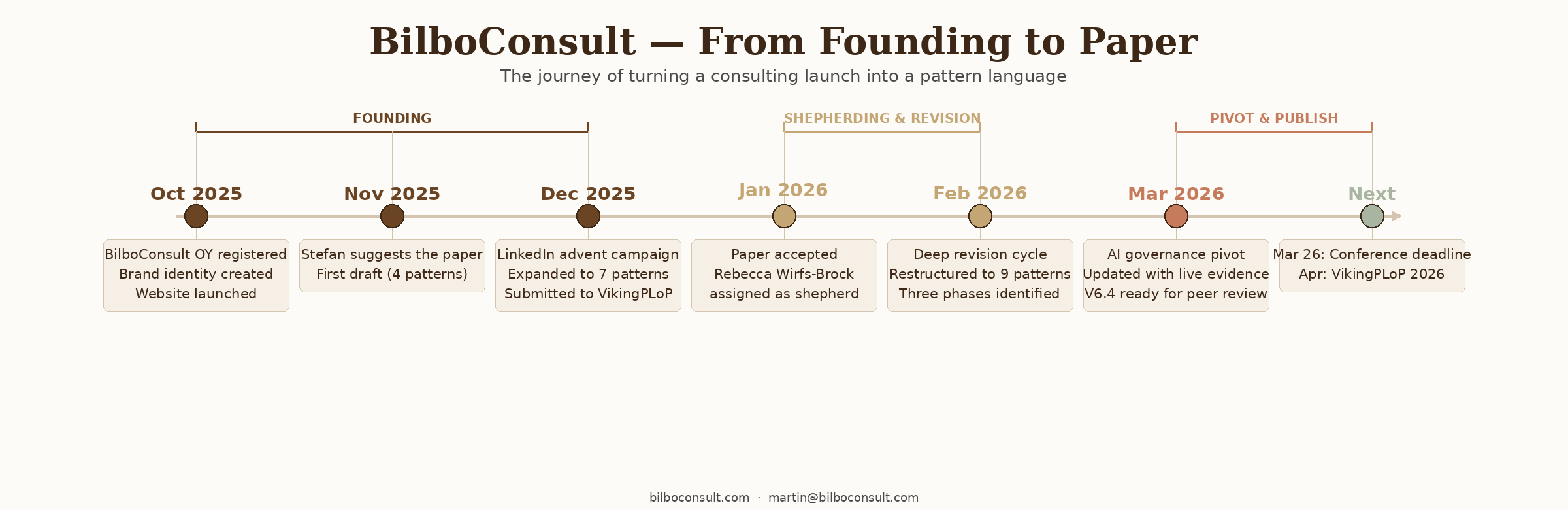
BilboConsult journey: October 2025 – March 2026
What makes this paper unusual for the academic world is that it’s a live field report. I’m not looking back on a successful journey — I’m writing from the middle of it. The paper documents real mistakes (like marketing to the wrong beachhead for two months because of confirmation bias), real pivots (narrowing from broad SIAM transformation to AI governance advisory), and patterns where the outcome is still unknown (I haven’t closed my first client yet, and the paper says so).
Why I’m sharing this now
The paper will be presented at VikingPLoP 2026 in April. The conference version deadline is March 26. Before submitting, I want to do something the academic process doesn’t always allow: open the paper to broader peer review.
I’ve been fortunate to work with Rebecca Wirfs-Brock as my shepherd throughout the process. Her feedback has been invaluable. But a paper about consulting practice deserves feedback from other practitioners — people who’ve started practices, navigated the credibility gap, and built client relationships from scratch.
Share your perspective — or join the peer review group
The paper includes ten reviewer questions embedded throughout the text, designed to guide feedback on the patterns, the honesty of the narrative, and whether the framework resonates with real experience. But you don’t need to follow those — any perspective is welcome.
If something rings true, tell me. If something feels off, I want to hear that too. A quick comment is just as valuable as a detailed review.
For those who would like to go deeper, I’m forming a small peer review group of practitioners willing to read the paper and share structured feedback. This isn’t a formal academic review — it’s a conversation between people who’ve navigated similar terrain.
What’s involved:
Read the paper (~8,000 words, 30-minute read)
Share your thoughts — on the embedded questions, or in your own way
Feedback by March 24 (so I can integrate it before the March 26 conference deadline)
You’ll be acknowledged in the paper’s acknowledgments section
Interested? Send me a message at martin@bilboconsult.com or comment below. I’ll share the paper with commenting access so you can mark up directly.
I’ll also be reaching out to a few trusted sparring partners directly, but the more diverse the perspectives, the stronger the paper becomes. If you’ve started a consulting practice, navigated a career transition into independent work, or simply have a practitioner’s eye for what rings true — I would value your input.
Martin Kallenbach is an independent IT management consultant at BilboConsult OY, Helsinki. He brings four decades of transformation leadership across Cognizant, Tieto, HCL, Nokia, and AXA Tech to help organizations navigate complex IT governance challenges.
To provide the best experiences, we use technologies like cookies to store and/or access device information. Consenting to these technologies will allow us to process data such as browsing behavior or unique IDs on this site. Not consenting or withdrawing consent, may adversely affect certain features and functions.
Functional
Always active
The technical storage or access is strictly necessary for the legitimate purpose of enabling the use of a specific service explicitly requested by the subscriber or user, or for the sole purpose of carrying out the transmission of a communication over an electronic communications network.
Preferences
The technical storage or access is necessary for the legitimate purpose of storing preferences that are not requested by the subscriber or user.
Statistics
The technical storage or access that is used exclusively for statistical purposes.The technical storage or access that is used exclusively for anonymous statistical purposes. Without a subpoena, voluntary compliance on the part of your Internet Service Provider, or additional records from a third party, information stored or retrieved for this purpose alone cannot usually be used to identify you.
Marketing
The technical storage or access is required to create user profiles to send advertising, or to track the user on a website or across several websites for similar marketing purposes.